Notes on Traveling to Southeast Asia

14 April 2024
Precarious Transport in Bali
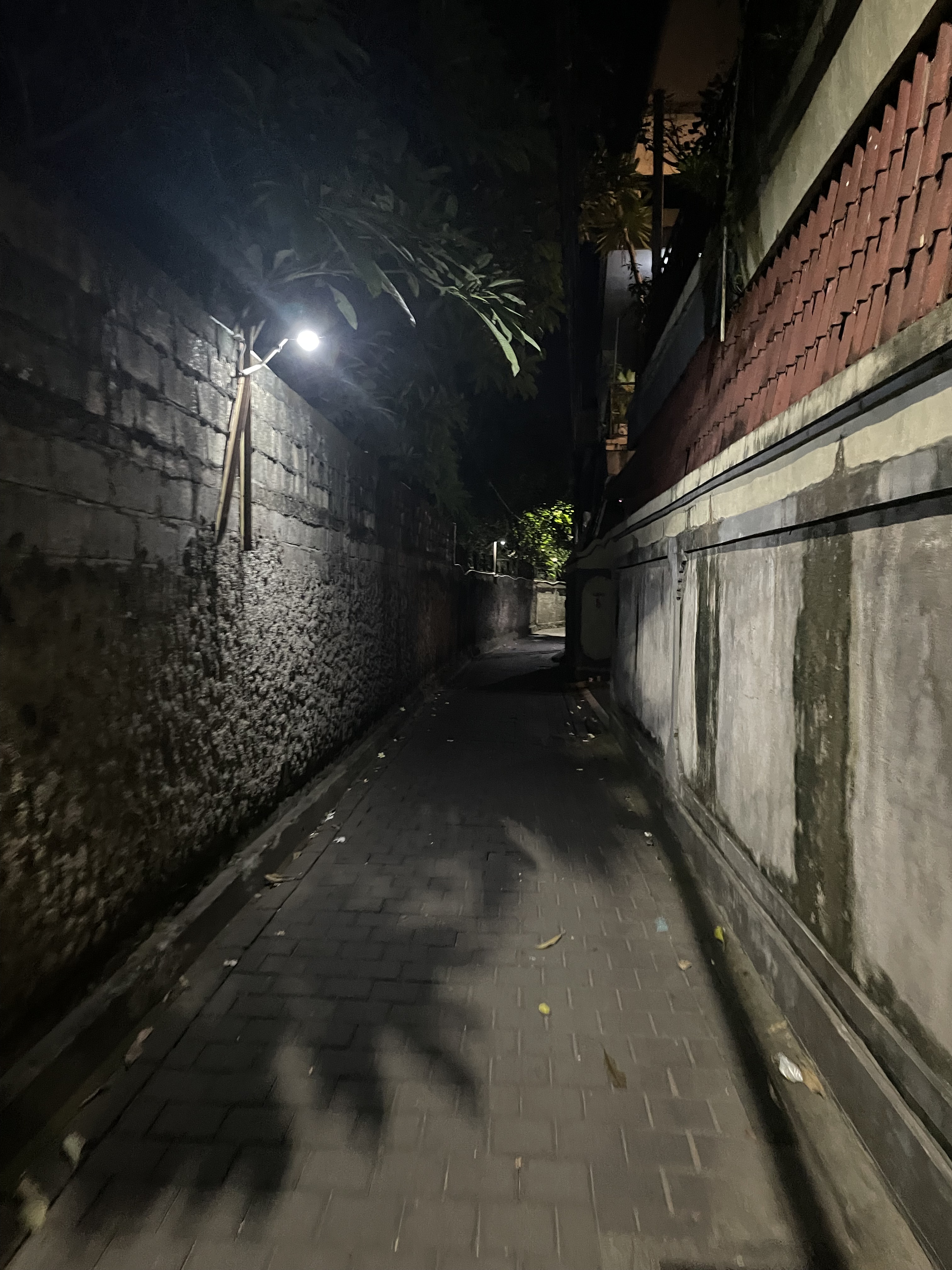
The humidity hits like New Orleans but the air smells different. I find my way to my taxi outside the airport in Bali. The taxi’s AC is welcome but blows pathetically like it’s been overworked and under-serviced. My driver hands me his phone with a cracked screen to type in my hotel name — at least I feel in control of where I’m going. I make nervous small talk and ask him if he’s from Bali. He’s from Java and came here to work. After exiting the airport complex, we slowly move through small streets. His manual car sputters in low gear. Construction makes the phone route impossible. We get lost. His phone internet stops working, so he turns it off and on again. The car putters along at ~20 km per hour. His head pivots between looking up over the steering wheel and then down at his phone. He pulls over three separate times to ask for directions. The helpers each point where to go, but I’m losing confidence. I have to be on Zoom for an oral exam defense in two hours (1:30 am Bali time). We stop a fourth time. The farther we go, the quieter the streets. This hotel was supposed to be a mile from the airport and it’s now been over 20 minutes. He finds a new alley to go down — the street name is spray painted on the wall. His car won’t fit. He stops a fifth time. The person he’s talking to takes a drag of his cigarette, points, and nods. The driver comes back and informs me I’ll have to walk, which is fine because I believe more in my feet than his driving at this point. I tip him 50,000 Rupiah, a quarter of what the ride costs, and head down the narrow side street. The rhythmic clicking of my bag wheels on the patterned path feels disruptive on an otherwise quiet street. After a hundred meters or so I arrive at the hotel. There’s decent Wifi but only in the restaurant, not in the rooms. I shower and take a deep breath. The oral defense goes well.
Jet Lag
Overcoming 12-hour jet lag is a moving target. Much like dieting, everyone has something they swear by until it stops working and they move on to the next thing. My overall strategy is to sleep as much as possible whenever I can while traveling but then once I land I aggressively employ caffeine, sunshine, exercise, and social outings to keep me up until after dinner. When I wake up in the middle of the night, I use those opportunities to pretend like I can sleep in as long as I want (something I usually wish I could do). Once up, I read and journal. Today, I’m reading “If You Leaves Us Here, We Will Die”: How Genocide Was Stopped in East Timor by Geoffrey Robinson.

Read Before Landing
I am so grateful for my study abroad experience to Turkey as an undergrad, which included a 1-credit course of readings and discussions before we departed. I read about Islam, the history of Constantinople, early religious sites in Turkey, and even a recommended novel by a Turkish author. That was my first major trip abroad besides a high school choir trip to Austria/Hungary and a trip over the border to Toronto, but it embedded deep in my mind the valuable lesson to “read before landing.” And not just anything or one thing but read broadly: history, culture, literature, and language. Much to the dismay of my wife at first (she’s used to it now, though), I’ve kept up this practice and ordered a handful of books before my trip. Reading about the atrocities and genocide in Timor-Leste before I arrive has been heart-wrenching but fills in much-needed gaps in my knowledge. I have been shocked and saddened by the US role in essentially giving the Indonesian government the green light (and the weapons) to invade the country in 1975. I want to acknowledge that fact – in a careful way – before I conduct the leadership development workshops I’m doing this week. And I suppose that any good I end up doing while I’m here is all I can do about the wrongs of the past. And I suppose that’s all anyone can hope about the future – that those who come after us will work to right our wrongs and learn from our sometimes horrific mistakes.
From Researching to Actually Doing Regional HRD in ASEAN
While I lay in bed in the middle of the night, it dawns on me — In 2016 I wrote my first conference paper in HRD in ASEAN. Then Alex and I presented our conference paper about Regional HRD in 2018, which turned into our award winning HRDI article published in 2022. We also published another book chapter and two other articles on the topic of HRD in Southeast Asia and ASEAN. In those projects, we pored over thousands of official ASEAN documents, speeches, and communiques looking at instances of identifiable HRD in the region. Now eight years later, I’m in Timor-Leste for my first time to participate in the Future Leaders of ASEAN program. It hits me that I made the shift from researching to actually doing and participating in regional HRD in Southeast Asia. I text this realization to Alex on WhatsApp. What a long way I’ve come. The scholarly journey can be tough because it’s a slow process of doing good work and building relationships with only sporadic acknowledgments of your progress. I think especially in a place like Southeast Asia where status and networks matter so much, I can’t just come in as a young hotshot and expect anyone to care. It’s been such a slow process. As I think back, it’s been people like Gerry Fry, Amp Lao, Bob Aubrey, Lorraine Symaco, Sukanya Chaemchoy, Earth Kulophas, and many others. They have believed in me and empowered me along the scholarly journey. And it hasn’t just been one way. I have sought to use my skills and energy to support their work as well for the betterment of the lives of people in the region.
Onward.
 Oliver S. Crocco
LikeLike
LikeLike