
I love old books
Posted on September 29, 2023 Leave a Comment
September 29, 2023
I love old books. My father worked with old books as a librarian at Princeton and Yale, so there’s something familiar and calming about them for me. When I was in high school, I stumbled upon and read B.F. Skinner’s Walden Two (published in 1948), which fueled my interest in psychology, organizations, and community. This affection for old books was part of my motivation for writing a post in the Academy of Human Resource Development’s monthly newsletter on “Uncovering the Value of HRD’s Seminal Writings.” The newsletter was published earlier this week and I thought I’d share it here as well.

Here’s the post:
When I took Neal Chalofsky’s course on the Foundations of Human and Organizational Learning at the George Washington University (GW) in 2014, I remember being frustrated reading seminal texts in the field of HRD. I thought, “Why are we reading these old books and articles instead of the most recent, cutting-edge research in the field?”
I had a lot to learn about the value of seminal writings.
Now, nearly a decade later as a faculty member at Louisiana State University, we are in the process of moving buildings and getting rid of some old books in our office. Many of these books belonged to AHRD Hall-of-Famer Ed Holton and longtime AHRD member, Reid Bates. Among the collection, I found a first edition copy of the “Training and Development Handbook” (1967) by the American Society of Training and Development (ASTD), the organization from which AHRD was born. Somewhat embarrassingly, the only name I recognized in the handbook was Donald Kirkpatrick. I found a first edition of “The Handbook of Human Resource Development” (1984) edited by Leonard Nadler, who founded the first HRD graduate program in the United States at GW in the 1970s and coined the term “human resource development” at an ASTD conference in 1969. I was proud to find chapters by two of my former GW professors, Mike Marquardt and Neal Chalofsky, in that first handbook.
As I dusted off more of the books, I found several volumes in a series called “New Perspectives in Organizational Learning, Performance, and Change” edited by the late Jerry W. Gilley, which included “Philosophy and Practice of Organizational Learning, Performance, and Change” (2001) by Gilley, Peter Dean, and Laura Bierema – back when AHRD’s Past-President was in her early years as an Assistant Professor at the University of Georgia. This was next to another book in the series: “Critical Issues in HRD” by Ann M. Gilley, Jamie Callahan, and Laura Bierema. Harbingers of great scholarship to come.
After reading through chapters of these and other books in the collection, I have come to appreciate the value of these seminal texts for our scholarship today. Of course, they are not the only seminal texts in our field and are not without criticism. They were mostly written by U.S. American white men and talked overwhelmingly about performance and the financial reasons to develop people. But I think there are a few key reasons that today’s HRD scholars and students should consider revisiting our field’s seminal writings.
First, they capture the historical development of the field. Without these readings, we can’t understand the historical legacy and the roots of our intellectual development.
Second, they show all the hard work of so many great scholars to bring us to where we are today. The field was in its infancy in the 70s and 80s. We wouldn’t be where we are today without the tireless and expansive work of so many excellent scholars and students. And for you students out there, the famous Kirkpatrick model started as his doctoral dissertation. Students should be encouraged that their dissertations have the potential to become the seminal texts of the future.
Third, but certainly not last, they give us a glimpse of what is yet to come. Reflecting on the past is an excellent way to envision the future.
Reading seminal texts still fills me with a mix of emotions: fascination, frustration, and curiosity. While I encourage you all to sign up for email alerts from our four AHRD-sponsored journals, so you can keep up with the latest trailblazing research in our field, I want to recommend that all of us take time to reflect on the foundations of Human Resource Development. One starting point is Darlene Russ-Eft’s (2016) piece in Advances in Developing Human Resources on “Controversies that Shaped the Field of Human Resource Development.” Another place to begin is the most senior HRD scholar you meet at the upcoming AHRD conference in Washington, D.C. in February 2024. I hope you consider joining and having a candid conversation with those most senior among us about how we got where we are today and where we might consider going from here.
There is so much to learn about moving forward from reflecting on the past. Onward.
A place to go when you’re broken
Posted on April 30, 2023 Leave a Comment
30 April 2023
When I was in college, I broke my collarbone playing ultimate frisbee. The quad where we played pickup on Fridays was riddled with Whitworth’s pine trees; the cross-cutting sidewalks served as end zones. People often think I broke it by running into a tree but actually it happened when another player fell on top of me after getting tangled in the air. It was the end of the spring semester of my sophomore year and finals were around the corner. It was also when my parents split up.
As the semester came to a close, I was broken physically and emotionally. I could hardly sleep. I was far away from home. Stress began to mount about how I was going to finish my courses. At an RA meeting, I admitted to my fellow RAs and my mentor Resident Director that I was not okay. I wept in front of them. The RA next to me put his hand on my back.
I’m not exactly sure how the news spread but one of my professors, Dr. Jim Edwards, called me on my flip phone and recommended I come and stay with him and his wife (my ballroom dance instructor) while I recovered. I said I would think about it. My mind was swirling and I felt disoriented.
Then, a day or two later Jim showed up at my dorm unannounced — a quite unusual occurrence — and sternly but gently recommended I pack a bag and come with him. I thought to myself, “what about my courses and finals? What about my RA duties?” They would all be taken care of. I could let them go. I needed to get to a safe place to heal.
At Jim and Janie’s house, I began to recover. My collarbone needed surgery. I can’t remember exactly how long I stayed there but it was around a month. I stayed in their son’s old room and ate three meals a day with them. Since I loved reading and had little else to do, Jim gave me books to read and we discussed them at dinner. I finished one every day or two. One of the first books was The Long Walk by Slavomir Rawicz, the true (but likely embellished) story of Rawicz’s escape from the Russian Gulag and subsequent 700-mile trek across Siberia to freedom. I imagine Jim thought I needed that kind of story to connect me with the journey of life and recovery. I also read Here I Stand about the life of Martin Luther — another account of bravery.
When I wasn’t reading, I was enjoying tea on the back porch overlooking their massive and colorful garden. Janie and I spent many hours in conversation. I loved hearing about their lives and travels. [The next year I would join their study abroad program in Turkey.] We also discussed my parents. One time, I remember she even got out the traditional marriage vows and talked them through with me line-by-line. I appreciated her sincerity and loved her company but I wasn’t particularly moved by the message at that time. That was okay, though.
I continued recovering from surgery, finished my incomplete classes, and returned home to New Jersey.
How fortunate I was to have a place to go when I was broken! How thoughtful and caring it was for Jim and Janie to take me in. American universities originally functioned in loco parentis (in place of a parent), and I experienced that at Whitworth. I am so grateful for their willingness to step into my life. This experience has colored my view of higher education and how important it is to intervene when we witness suffering. I think that bringing people into our lives — sharing our homes, conversations, meals, books, and gardens — is perhaps the most powerful way to support others.
I’m not exactly sure why I thought about writing this today. Part of it is likely because I recently traveled for a few days and stayed in the home of my good friends and former adviser while we worked on a few research projects. I’ve also been getting more involved with undergraduates at LSU, which makes me reflect on my own experience and the responsibility of my role as a faculty member. Life is so short and full of wounds. But healing and recovery are possible through community. I believe this firmly.
Onward.
I judge a university by its trees
Posted on April 20, 2023 Leave a Comment
20 April 2023
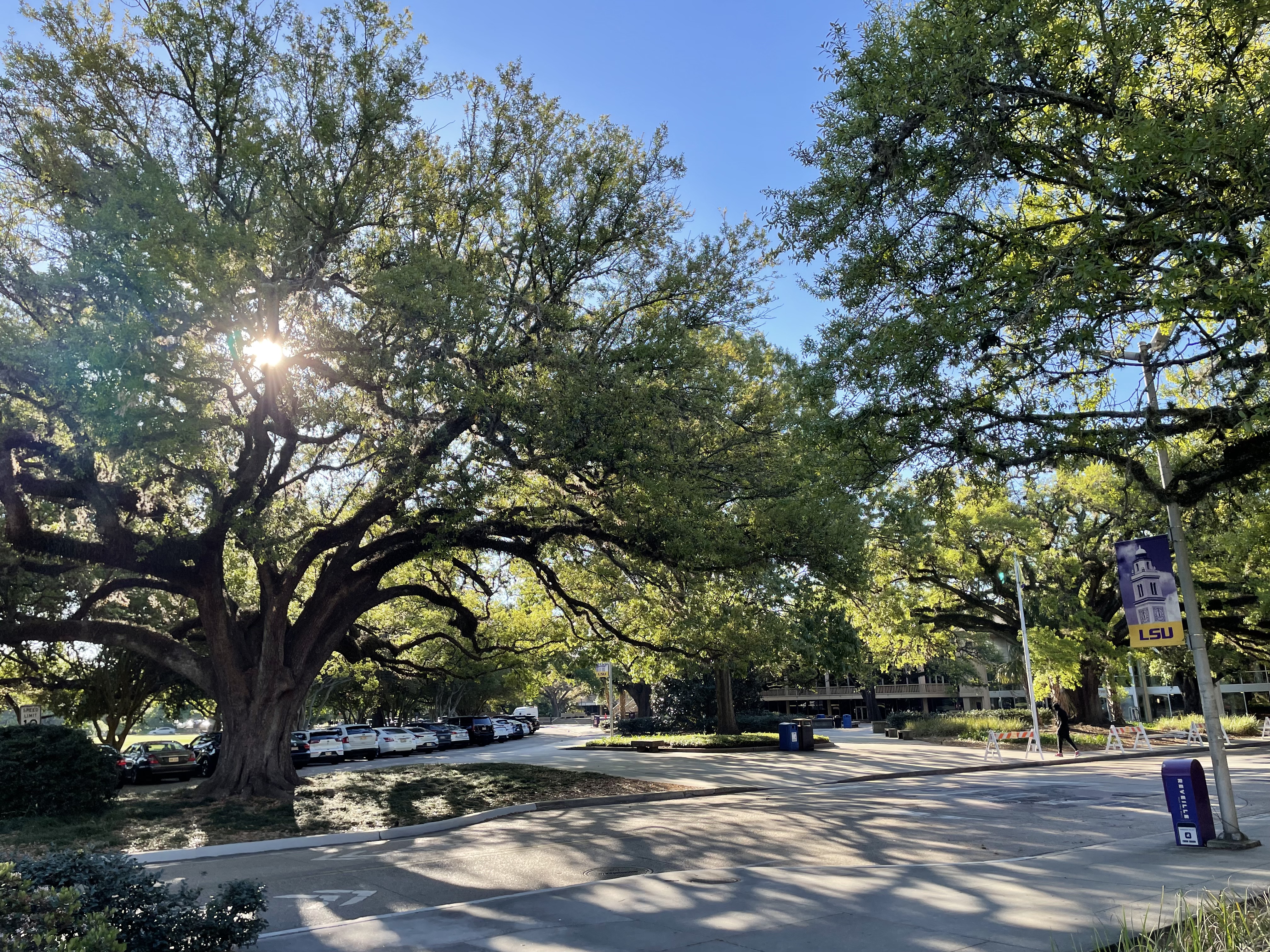
I judge a university by its trees,
for trees are metaphors
for the intellectual life.
Trees need space to grow
both above ground and below.
And under the footsteps of passers by
no one sees how they struggle
and stretch blindly in the darkness.
Trees do not grow quickly,
but each day there is change —
movement and growth, however slight.
Their branches extend in different directions,
creating much-needed balance.
Trees, most of them at least,
go through seasons of bloom
where they look unstoppable,
confidently meeting each morning
with joy as sunlight shines through.
But trees also wither,
losing their appearance of life.
Depression comes, and they
doubt if they will ever return
to the best version of themselves.
Still, it is gentle progress, even in darkness
with trust in the work
and mindfulness of the journey,
that reminds them, and us,
what it means to be alive.
An annoying paradox of deep learning
Posted on April 10, 2023 2 Comments
10 April 2023
I’m listening to the popular 2021 book Range: Why Generalists Triumph in a Specialized World by David Epstein. I feel like I’ve somewhat outgrown these types of books (journalist-authored, story-based, pop social science), but I like the general idea and it was for sale on Apple. I’ve always been more of a generalist despite the common narrative in society (and my profession) that specialization is everything.
In Chapter 4, Epstein talks about what I would call “the annoying paradox of learning” which is essentially that the most meaningful learning we do is often slow and even frustrating. It involves taking risks, making mistakes, asking questions, and being confused. It’s a paradox because mistakes and confusion feel like the opposite of learning. It’s annoying because we wish it didn’t have to be that way. But when we try to speed things up to boost performance in the short term, it almost inevitably undercuts our learning. It’s why Jonathan Haidt in his book The Happiness Hypothesis: Finding Truth in Ancient Wisdom admonishes readers that they’re welcome to skip to the end and read the main ideas but it’s the journey of the book that will lead to deep understanding. [Haidt’s book, which I read in 2011 in Cambridge, is one of my all-time favorites.] The idea that deep learning is slow and hard harkens back to the crucial role of a “disorienting dilemma” in Transformative Learning Theory.
It also reminds me of my personal experience learning statistics in grad school. At GW, I took every statistics course I could fit into my schedule. The intro classes came with exercises and PDF instructions on what to input into SPSS and what we should get out after doing so. Essentially, we weren’t learning anything fundamental about the principles of statistics. We were learning how to follow a manual. It wasn’t until I took regression and then structural equation modeling and then item response theory –– when I had what I might have labeled “bad teachers” –– that I really began to learn the foundations of statistics. It was only when my friend Zach and I toiled in the basement of the Gelman Library in Foggy Bottom that the lights began to turn on. We would sit at adjacent computers (each with our coffee from the Starbucks above) and work on analyses independently, but together. We had endless moments of frustration followed by fleeting moments of eureka. When we briefly understood something, we would spin our chairs toward each other and try to explain it in plain English, which inevitably led to questions and then, “okay… hmm… I’m not quite sure… let me think about that.” Questions begot questions.
I looked through old photos to see if I could find one from those days in the library. This is the only one I could find. My face says it all. Ha!

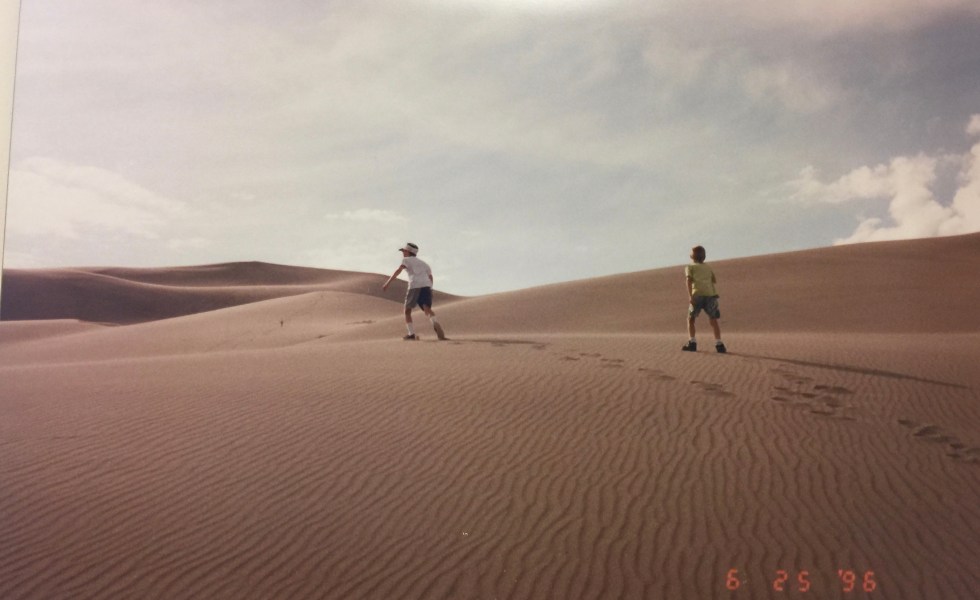
Last fall, I remember sharing with my doctoral students in Advanced Mixed Methods Research that learning research methods and completing a dissertation involves going out into the desert. [The featured image above is of my brother Louie and me journeying in a Colorado desert in 1996.] The doctoral journey can be lonely and frustrating and terribly slow. But that may be the ONLY way to deeply understand research methods and complete a dissertation. It is a (mostly) self-directed process that involves dealing with ambiguity and questions at every turn, which the learner is responsible for exploring.
As professors, we do our students a disservice by valuing expedient performance instead of creating environments where slow struggle can occur. Of course, part of the problem is that students have become accustomed to a type of learning built around “just tell me what to do and how exactly to do it and I’ll do it.” For more on this, check out William Deresiewicz’s 2015 book Excellent Sheep: The Miseducation of the American Elite and the Way to a Meaningful Life. This means that creating an environment for good struggle is not often warmly welcomed. It’s mistaken as poor quality of instruction or dismissed as unnecessarily difficult. For understandable reasons, students want quick learning, high grades, and some kind of extrinsic recognition like a degree, credential, or certificate they can post on LinkedIn. I don’t blame them. Students are busy, and so much of our society is built around résumé-type “learning.”
But a good parallel is athletics. If I were a track and field coach, would I be doing my athletes any good by making practice quick and easy? Teachers, like coaches, are responsible for creating assignments that will kindly push our students in meaningful ways, but no one can run the race for us. I’m grateful I did track in high school and continued a habit of training for long-distance athletic events. The parallel with daily training towards a seemingly impossible goal has been helpful to me. [I ran a 50-mile ultramarathon the same month I completed my comprehensive exams.] This is a tricky line to walk with students, though, and I’m working on becoming a better teacher/advisor.
In my own life and work, the first thing I do in my office on many mornings is read a journal article or book chapter out loud while taking notes. It’s hard to do when email and to-do lists are shouting at me, but reading out loud slows me down and helps me to think as I read. My favorite pen (a Pilot G-2, 0.38) allows me to write down little notes that aid my cogitation. Reading out loud is a slow process, but it’s one of the core practices I would credit with my success as a learner and scholar. Slow > Fast.
Funnily enough, common advice for ultramarathon racing is “start slow, and then slow down.” The same probably applies to deep learning, too.
Onward.
Spending a few seconds this morning being mindful and grateful
Posted on March 30, 2023 1 Comment
March 30, 2023
It’s an ongoing joke between Khai and me that whenever I travel, I enthusiastically remark, “I would love to live here!” Notable recent examples include Bangkok, Bristol, and Boothbay. On the one hand, my comment is an expression of the honeymoon phase of travel, where I am easily biased toward novelty. On the other hand, I honestly believe I could adapt to enjoy living nearly anywhere. That’s partly due to my privileged positionality in society, but it’s also my personality as someone who intentionally focuses on the positive characteristics and potential of a place. I allow myself to learn and be gently shaped by my surroundings while also finding ways to contribute my gifts and passion. As a result, I’ve lived happily in many different places, like Princeton, Spokane, Chiang Mai, Cambridge, Washington DC, and now Baton Rouge.
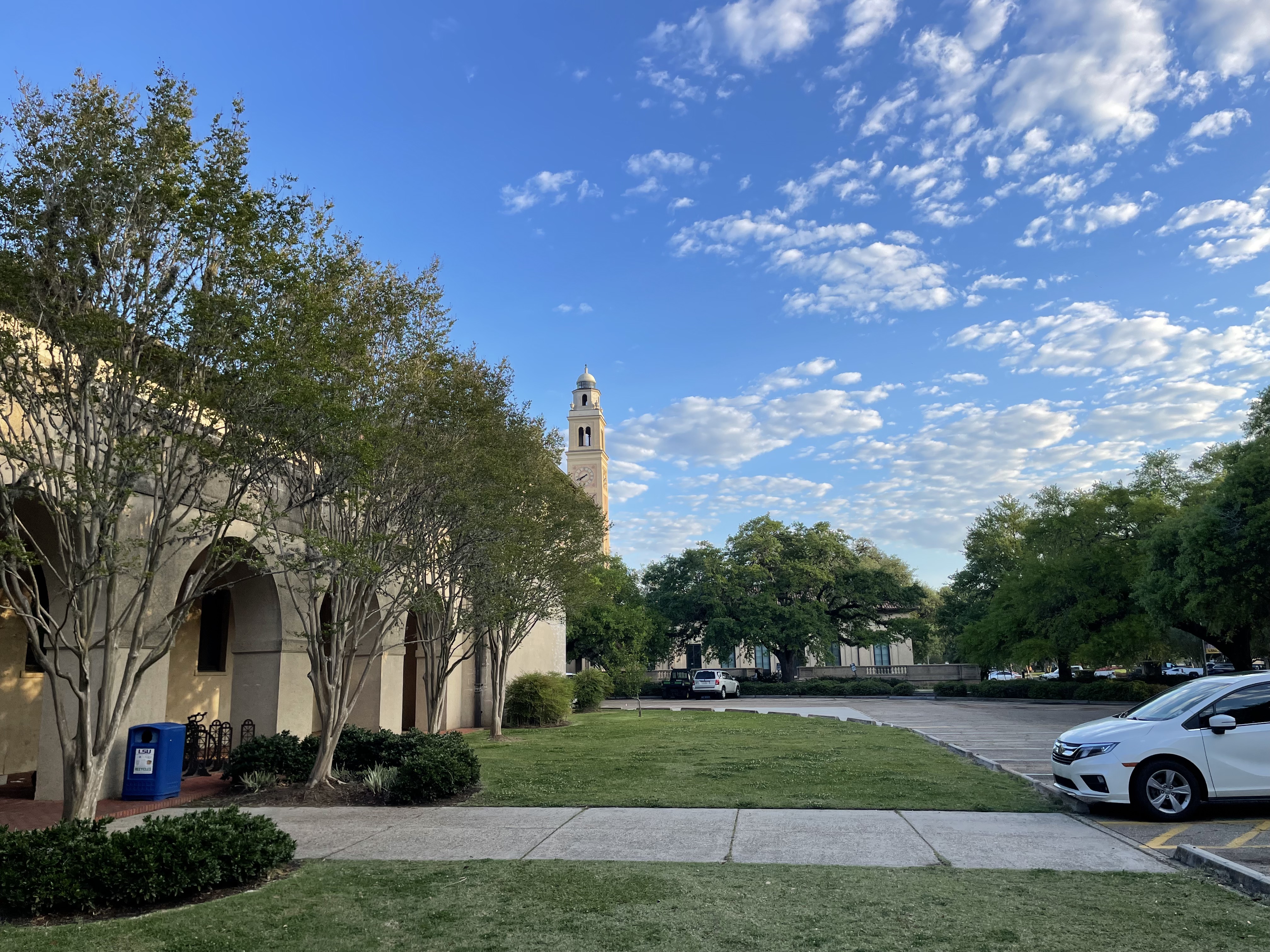
This morning I woke up early, snuck out of the bedroom, and met my clothes laid out in a row on the coach where I had left them the night before. I rode my bicycle during the cool, quiet morning as the sun began shining through the trees. Biking occasionally feels like a chore, no doubt, but the cardio inevitably gets my heart and spirit spinning in the right direction. I got to campus on this definition-of-spring day, grabbed my special coffee that I use for writing days (a triple-shot hot vanilla latte), and snapped a few pictures before heading up to my office.
How fortunate am I to live here?
How fortunate am I to work in this building with a window facing the parade ground?
How fortunate am I to have a job I love that provides for my family and enables us to thrive?
I hope to bend this fortune/luck/privilege/blessing toward building a world in which more people have the opportunity to feel the same. There is much progress to be made. LSU’s campus is, after all, built on land originally belonging to Indigenous people who were unjustly and violently persecuted and removed. The campus still holds two ceremonial Native mounds that have lasted millennia. There is so much pain in the world — past, present, and yet to come. As someone who leans toward optimism, it is even more crucial to learn from history and be mindful of all the work still to do. May I continue to do this work and use my life to learn, serve, and contribute to our world’s collective flourishing.
Onward.
The quiet parts of academia
Posted on March 27, 2023 Leave a Comment

I like the quiet parts of academia.
Quiet offices and libraries.
Staring out windows, the noise outside dulled by a windowpane.
Quiet reading and thinking.
(Sometimes thoughts are noisy, though.)
Quiet writing, except for the clanking of keys, of course,
but even that is punctuated by pauses.
The quiet parts are my favorite.
They’re much different from inboxes, which are quite noisy.
The best way to keep inboxes quiet is by keeping them closed.
Responding to them doesn’t seem to work. It just makes them louder.
Is it spring yet? Updates on a full winter.
Posted on March 9, 2023 Leave a Comment
March 9, 2023
In my mind’s eye, winter is supposed to be the calm part of the year where I stay indoors and store up energy for a busy spring. Not this year. The year 2022 turned into the year 2023 while we were in Pittsburgh visiting family. I flew there with the kids while Khai did her citizenship interview in New Orleans (which went well, yay!) and then she met us a couple of days later. We had a long and rewarding visit with my dad and Beth, my uncle Hi, and my aunt Anne. The kids even had their first sledding experience! When we tried to leave in January, our flight only had one seat available, so Khai and Alice flew back while Aden and I stayed another 48 hours. To distract ourselves from being apart, Aden and I went to a trampoline park and had a blast.

After a week back in Baton Rouge, I flew to Thailand to guest lecture at Chulalongkorn University. It was so great to be back face-to-face with those students and colleagues. I also had the opportunity to commune with several of my Thai co-authors and research partners. I’m reminded of the special importance of face-to-face interactions in the Thai context. As much as I love Zoom and WhatsApp, there’s nothing like face-to-face.

Back in the States, it was a busy start to the semester with lots of happenings. The most exciting was that Khai had her naturalization oath ceremony and became a US citizen! We celebrated with a Thai lunch at the New Orleans restaurant Pomelo. At LSU, I’m teaching online this semester, but it still seems like I don’t have enough hours in the day to do everything I’d like to do professionally. That’s also because I’ve been intentionally spending more time at home with family and pursuing my passion (reading). My former advisor and dear friend, Maria Cseh, is a good model of a life where work is important but should never take priority over spending our best hours with loved ones. What message am I sending my kids if I come home exhausted? I’m willing (and in a place of privilege to be able) to sacrifice some “productivity” for quality of life.
Last week, the Academy of Human Resource Development where I serve on the Board of Directors had its first in-person conference since 2020 — and it was incredible! I forgot how much I love being around people, talking about somewhat esoteric (but hopefully relevant and significant) topics, and contributing to a scholarly community. I was one of the facilitators of the Future Scholars and Leaders Colloquium (formally the Graduate Student Colloquium) and it had a record 64 graduate student attendees. My big impression of the conference was that the Academy is in good hands given the brilliance and energy of that group. Now it is up to those of us in leadership to be good stewards of the Academy and support those students in their growth as scholar-practitioners.
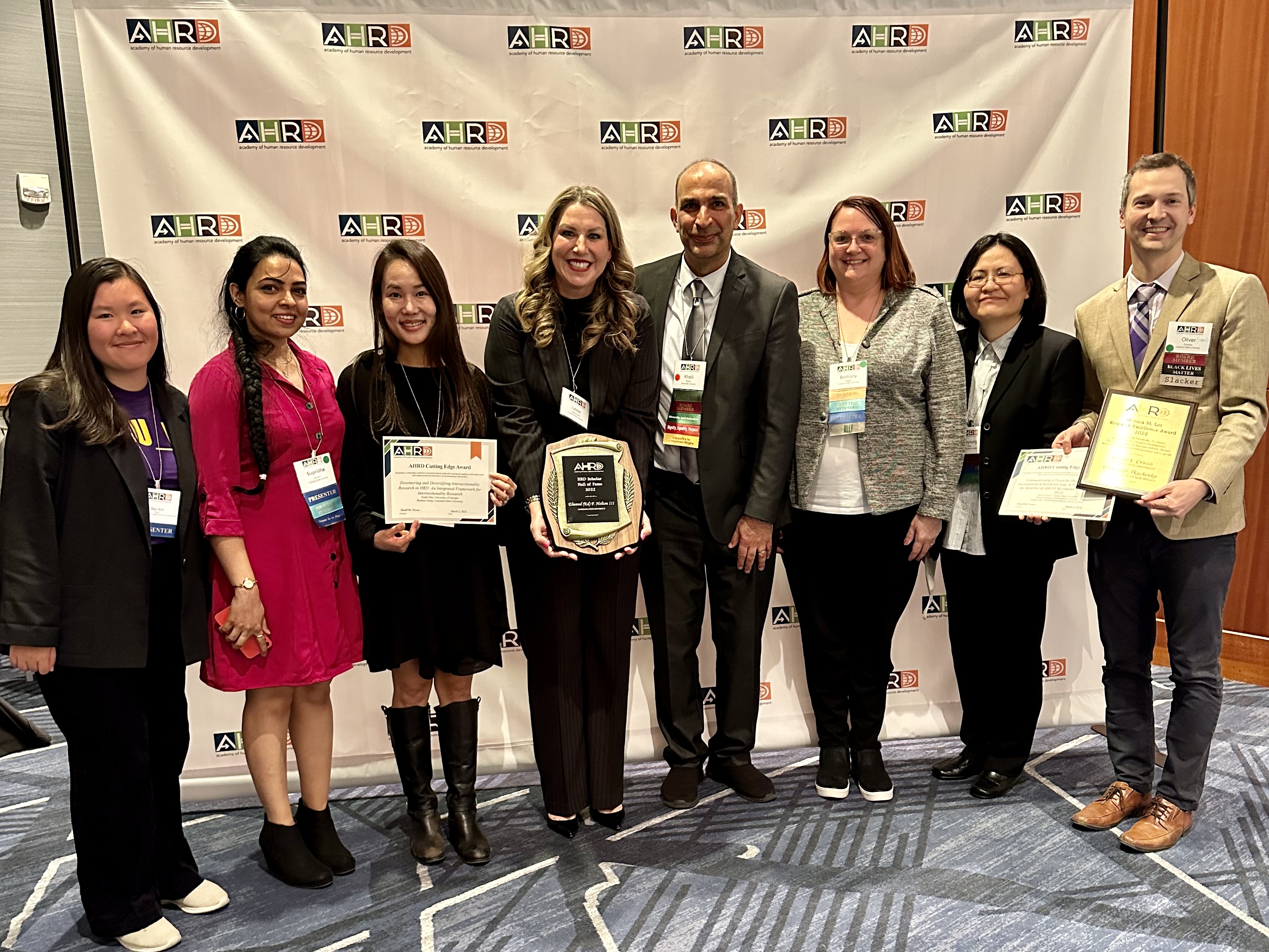
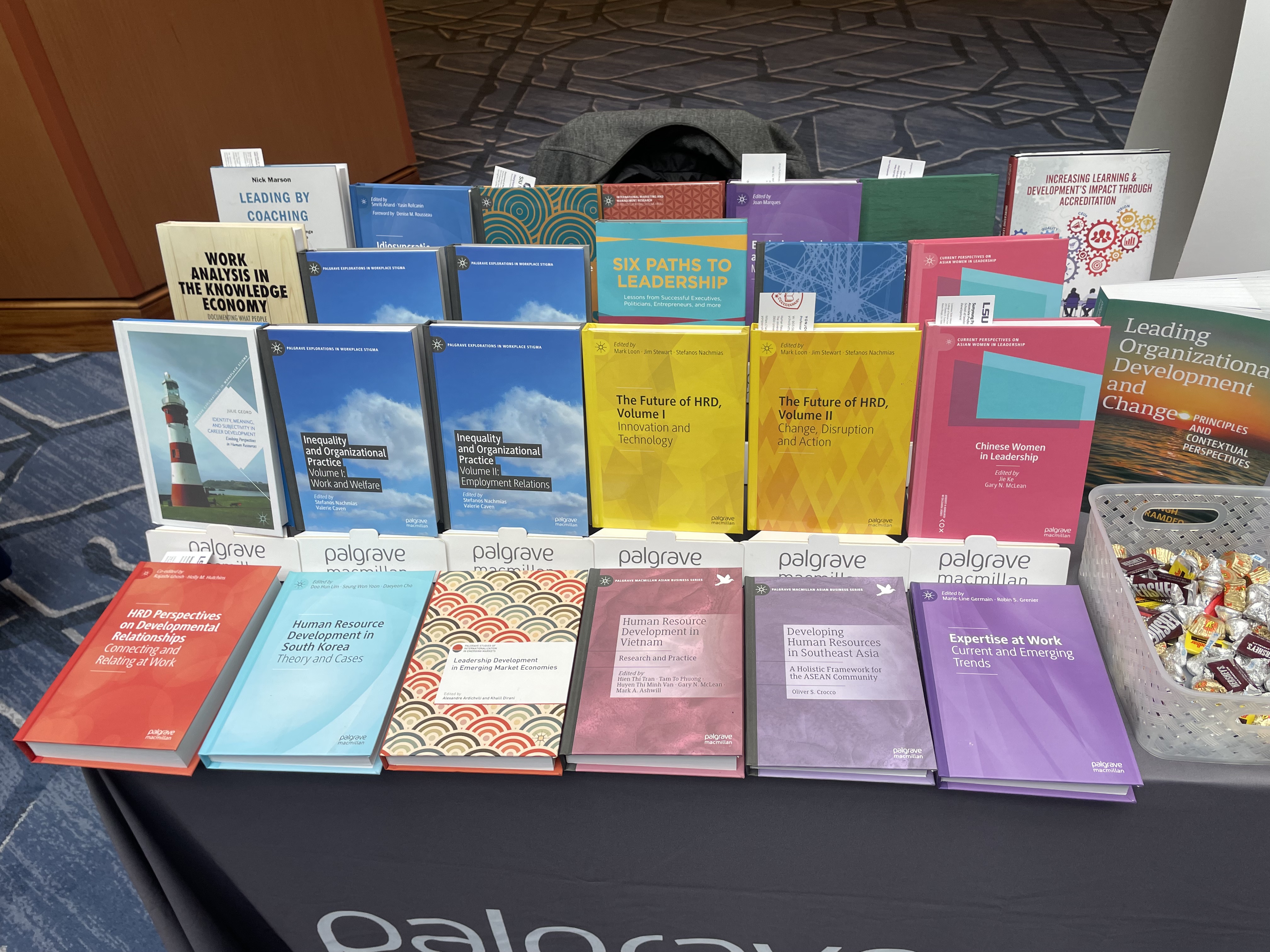
LSU had quite a showing at the conference, despite only a relatively small group of us attending. Between my colleagues Shinhee Jeong and Sunyoung Park, the three of us represented 3 of the 7 Cutting Edge Awards given out to the best conference papers. This was my first Cutting Edge Award, so I was delighted. I also was honored to win the Monica M. Lee Research Excellence Award for my paper with Oleksandr “Alex” Tkachenko on regional human resource development in Southeast Asia and ASEAN. This award goes to one outstanding paper published in Human Resource Development International each year. It’s been a long journey since Alex and I started that project back in 2018 when we first presented a working paper on the topic at the Asian AHRD conference in Bangkok. It was finally accepted in 2020 but didn’t come out in an issue until 2022. It took so long to come out in print that I even wrote a book on the topic, which came out in 2021! Oh academic publishing… Great to see my book Developing Human Resources in Southeast Asia in print at the Palgrave Macmillan table (bottom row, second from the right).
Wishing you all a wonderful end of winter! For me, I’m hoping things slow down a bit, but slowing down is a choice I need to work on making, too.
Onward.
New role as Associate Editor of Human and Workforce Development at the Journal of Tropical Futures
Posted on January 22, 2023 Leave a Comment
22 January 2023
As many of you know, a lot of my academic work has focused on issues of human resource development in Southeast Asia. After living and working in Thailand for four years and working on organization development in Myanmar, I have been deeply curious about the power of learning and change in communities, organizations, and the region as a whole.
Now, I am excited to announce the launch of a new journal published by SAGE called the Journal of Tropical Futures: Sustainable Business, Governance & Development where I am serving as the Associate Editor of Human and Workforce Development.

The journal is administered by James Cook University, Singapore, so it’s also connected to the community of scholars in Southeast Asia. Given my expertise in the region and passion for sustainable development, I was approached by colleagues familiar with my work to serve in this role, and I am very happy to do so given the mission of the journal:
JTF seeks to represent and address the complex and heterogeneous nature of the challenges facing these regions by exploring the interrelationship between business, management, political economy, development and the environment. We are particularly interested in the many tensions that exist between demands for economic growth, social and material wellbeing of populations and corresponding environmental impacts. Can the developmental needs of peoples be met in equitable ways by the expansion of business, trade and innovation in the tropics? What forms of responsible stewardship, organisational practice, resource management and governance might help navigate the unique and precarious concerns of the tropics?
https://journals.sagepub.com/description/JTF
Initially my section was titled “Human Resource Development” but the leadership team of the journal worked with me to revise it to “Human and Workforce Development” to better suit the journal’s description vision . The Editor-in-Chief, Peter Case, along with Managing Editor, Jacob Wood, and Chair of the Editorial Board, Eddy Ng, wrote a fantastic inaugural editorial where they recognize that the “complex challenges faced in the tropics demand multidisciplinary and transdisciplinary perspectives” (p. 6). The mention of transdisciplinarity pleasantly reminds me of the 2019 AHRD conference Townhall forum on that topic.
As an early career scholar, we are often reminded not to become overburdened with service duties. This is certainly a warranted precaution. That said, I am confident in my teaching and research at this moment and want to expand my reach to elevate important scholarship around human and workforce development in the tropics. The vision of this unique journal excites me, and I’m looking forward to contributing to its success!
Onward.
Repost: Using Poetry to Connect to the Work of HRD this Winter
Posted on January 3, 2023 Leave a Comment
3 January 2023
As Board Members of the Academy of Human Resource Development (AHRD), we take turns writing posts for the monthly newsletter, the AHRD Digest. This past month it was my turn, and I decided to write about poetry’s connection to HRD. I thought I would repost it on my personal website because it overlaps with what I write here.
Since it was published, a few people have reached out to me and two people have shared Marge Piercy’s poem “To be of use” which may be of interest. One of the people who shared that with me is my former professor Neal Chalofsky, author of Meaningful Workplaces: Reframing How and Where We Work, who uses it when he teaches his course on meaningful work.

Here’s the post:
Many of us spend our days in organizations, classrooms, and offices working on adaptive organizational challenges, designing learning experiences, and reflecting on multifaceted research questions. Our work as HRD scholars and practitioners is a life we’ve chosen out of our desire to lead the field and contribute to collective human flourishing.
I’ve been reading a lot of poetry over the last twelve months, which has helped me connect to the work we do in HRD. I also recently enjoyed the HRD Masterclass Podcast on HRD and Spirituality in Season 3. In our field, we work with real people in real organizations who have real struggles and real questions. Our colleagues, clients, and students face real pain and real joy. To support people in organizations, we shouldn’t limit ourselves to superficiality and hyper-intellectualism. Part of our work must be to engage, authentically and humbly, with the spectra of human experience. Reading poetry is a great place to start. It’s also a way to rejuvenate after overwork and exhaustion.
For those of us in academia, the calendar is punctuated with flustered semester endings, which lead into stretches of recovery and reflection. Rest is vital for us to continue to do the work we find meaningful. This focus on rest can be found in most of the world’s religious traditions and in recent secular writing like Rest by Alex Soojung-Kim Pang. Read along as Wendell Berry writes about rest and work in the poem “Sabbaths”:
Whatever is foreseen in joy
Must be lived out from day to day.
Vision held open in the dark
By our ten thousand days of work.
Harvest will fill the barn; for that
The hand must ache, the face must sweat.
And yet no leaf or grain is filled
By work of ours; the field is tilled
And left to grace. That we may reap,
Great work is done while we’re asleep
When we work well, a Sabbath mood
Rests on our day, and finds it good.
Much meaning can be made from this poem. Think about your work in HRD scholarship and practice. What words, lines, or phrases stick with you? What emotions does it evoke? Read it again if you’d like. Jot down a few ideas if you find it useful.
Poetry has much to offer HRD as a field, even though most of us likely wouldn’t find the two explicitly connected. Some of the poets I’ve been reading recently are Mary Oliver, Audre Lorde, David Whyte, and Rainer Maria Rilke. I’ve also been reading the poetry collection Leading from within: Poetry that sustains the courage to lead compiled by Sam M. Intrator and Megan Scribner. The Poetry Foundation also has many poems searchable by poet, topic, and title.
My hope for all of us this winter is to take time in solitude and rest to reflect on all that is meaningful to us in our lives and in our work. And if you’re stuck, try reading (or writing) a few poems. Onward.
Teaching One Thing in the World of Value
Posted on December 11, 2022 Leave a Comment
11 December 2022
A couple of years ago I read Ralph Waldo Emerson’s essay The American Scholar. One line of the essay has stuck with me and informed my teaching philosophy and practice:
“The one thing in the world of value is the active soul — the soul, free, sovereign, active.”
What does it mean to have a soul that is free, sovereign, and active? When I teach, I want my classes to be more than an intellectual exercise. I bring my whole heart and mind to my classroom and I want my students to feel welcome to do the same.
This semester, I started a new practice with my PhD students in my Advanced Mixed Methods Research course. I began each 3-hour class with 5-10 minutes of reflection on “One Thing in the World of Value.” One or two students signed up each week to share a poem, song, picture, quote, or idea that brings deep meaning to their lives. I modeled this practice the first day with Mary Oliver’s poem Wild Geese — one of my favorites. I also read a passage from Parker Palmer’s book Let Your Life Speak. Throughout the semester students shared poems, holy scriptures, pictures of family, and other text and reflected on how these things informed their worldviews.
I did this because I wanted to ground our study of mixed methods research in who we are as humans. I want my students to see research not as a list of steps to follow but as a holistic process of inquiry inextricably tied to their identities, passions, and experiences.
The beginnings of our classes were so special to me.

This idea of bringing our whole selves to the classroom reminds me of David Whyte’s book Crossing the Unknown Sea: Work as a Pilgrimage of Identity. In this book, Whyte uses the metaphor of the sea, boats, captains, and sailors to talk about leadership, work, and identity. He is also big on the idea of conversations. We have conversations with ourselves, others, and all the world around us. He writes:
“The core act of leadership must be the act of making conversations real. The conversations of captaincy and leadership are the conversations that forge real relationships between the inside of a human being and their outer world, or between an organization and the world it serves. All around these conversations, the world is still proceeding according to mercies other than our own. This is the ultimate context of our work. The cliff edge of mortality is very near. We must know how easy it is to forget, how easy it is to drift onto the rocks and put our lives to hazard. Everything is at stake, and everything in creation, if we are listening, is in conversation with us to tell us so.”
This has been the most rewarding semester of teaching in my academic career.
This semester I also got LASIK eye surgery. I had been wearing glasses for the last few years since contacts started hurting my eyes. There has been something strange about putting down my glasses, which has led to feeling like the real Ozzie is emerging more and more: The Ozzie of my childhood who wanted to invite everyone in the neighborhood to his birthday parties; the Ozzie of Princeton High School who read B.F. Skinner on the bus to track meets and then ran his heart out; the Ozzie of Whitworth who could be goofy one minute and serious the next; the Ozzie of Thailand who curiously learned as much as he could about Thai people and culture; the Ozzie of Harvard and George Washington who spent hours pondering interesting articles and books and then talking about them with classmates and housemates. I can’t help but feel that there’s some connection there. Even my students noticed I was different after the surgery.
As an aside, one of my old DC housemates tells the story of seeing me read a book in my chair as he left for work one morning and then coming back 8 hours later and finding me still reading in the chair. That’s also the real Ozzie: a learner, a writer, and a lover of truth, beauty, and goodness. I am so fortunate to live a life where I can continue to read, discover, and cultivate a soul that is free, sovereign, and active. And through teaching I can support others along the journey as well.
Onward.
 Oliver S. Crocco