6 Things Every Teacher Should Know
Posted on July 4, 2015 Leave a Comment
Recently, I was co-leading a workshop for high school students alongside three DC teachers. It was the first time I’ve co-taught something in a while, so it was enlightening. I’m no expert teacher but I’ve taught in diverse classrooms and have been trained by some expert teachers in my life. Most of these may be obvious but are too often underutilized. These apply mostly to my experience in high school and university teaching but I’ve used them with adults as well. Here are a few teaching ideas every teacher should have in their toolbox. Let me know what you think.
1. Don’t hand anything out to students while giving instructions. As soon as you start handing things out, students stop listening. Give your instructions first, then hand out whatever you need to.
2. Always stop fun games and activities BEFORE you reach the climax of fun and excitement. I know this is counterintuitive, but this will keep students interested, wanting, and anticipating the next activity. If you reach the climax (and go past it), students start getting bored and lose focus.
3. If you ask your students a question, don’t answer it yourself before your students have a chance to think about it. Silence is okay. Don’t rush to answer your own question. If no one is responding, wait in silence and/or repeat the question in a different way.
4. When students answer a question you’ve posed, don’t evaluate each response on the spot with stuff like, “That’s a good answer” or “That’s fascinating!” Doing so will make other students question themselves and lose confidence: “Is my answer good or fascinating??” It’s better to say things like “Thank you for your comment.” And if you think one is particularly interesting, point out what about the comment is noteworthy. “I appreciate how you brought in your personal experience in your response.”
5. Don’t use extrinsic motivators to get students to participate. For instance, “If you do this, I’ll give you…” or “the team that wins will get…” If you haven’t read Daniel Pink’s book Drive, do it. The thesis: extrinsic motivators displace intrinsic motivation. If you use extrinsic motivators to get students to learn, don’t expect students to care about the learning the moment the extrinsic motivators are gone.
6. Never do for a student what they can and should do for themselves. This is perhaps my golden rule of teaching. Teachers generally talk too much. Don’t get me wrong, I’m a firm believer in the role of the lecture but generally teachers do too much of the talking. In my experience, the more I am doing/talking, the less my students are engaged.
Here’s one way to solve the teacher-talking problem (this is called a Jigsaw activity): Say you have three case studies you want your students to know about. One way to teach those case studies would be to go through them, one by one, on the board. I don’t recommend that. Instead, why don’t you give one third of the class the text for Case Study A, one third of the class the text for Case Study B, and one third of the class the text for Case Study C. Have them individually read and make notes about the case study assigned to them and tell them that they will have to explain it to their classmates. Then break into small groups of three, one person from each case study and have the students teach each other about the case study they investigated. At the end, make sure every student has a copy of all three case studies to reference later, but don’t hand that out until after students have shared themselves. If at the end you desperately need to tweak something or summarize things, go ahead, but remember that if students anticipate you’re going to sum it all up at the end, they’ll be less motivated to learn the case study for themselves or listen to their fellow students in the future.
Do you agree?
What are some of your best teaching tips?

A throwback from my teaching days at Payap University
Changing the Discourse in Human Resource Development
Posted on June 28, 2015 Leave a Comment
As a young scholar, I get hard copies of the academic journals I subscribe to. I like to read through the articles and get a better grasp of what’s going on in the literature. One of these journals is the Human Resource Development Review (HRDR), edited by Julia Storberg-Walker of George Washington University. My friend and fellow doctoral student is the managing editor. HRDR’s articles tend to be more conceptual and theoretical than empirical. The June 2015 issue focuses on Critical HRD, which challenges dominant ideas in our field such as the notion that HRD is primarily about supporting the bottom line.
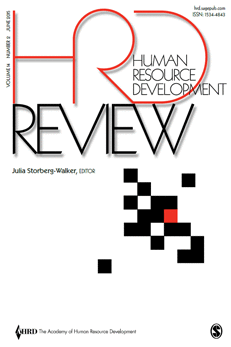 Laura Bierma of the University of Georgia (a veritable giant in HRD) wrote the guest editorial of this issue and highlights three themes of the issue, the second of which – “Changing the Discourse” – really stuck with me as I read. Here’s what she had to say:
“We talk HRD into being. How we speak about things is discourse. Perry (1992) suggested theories do not simply exist in the abstract until they happen to be scientifically discovered. Rather, theories are social constructions created between people as a means of making meaning about the world. Humans create shared interpretations that shape how they perceive, experience, and understand the world. People socially construct and share meaning through discourse.”
And to connect this to critical theory, she goes on to write, “Discourse is not a neutral, common understanding of social phenomena, but typically a byproduct of the assumptions and worldviews of the most privileged and dominant members of the society or social group.”
She gave the example of “work-life balance” (a phrase I often use). This is a phrase likely invented by Americans in the wake of the age of overworking. And Bierma argues it is no coincidence that “work” comes before “life” in that phrase. Instead, Bierma advocates the use of “life balance.” To most, this might seem like a petty detail with no significance. But then again, most people aren’t critical theorists.
For me, the takeaway is in the importance of mindful discourse. My program at GW chooses to use “Human and Organizational Learning” as the title of the program instead of Human Resource Development for this very reason. Should we regard human beings as “resources” that need to be “developed”? That’s a conversation for another time perhaps. In the meantime, I am seeking to be mindful of the messages that words and language convey.
Conference: UFHRD 2015
Posted on June 27, 2015 Leave a Comment
Earlier this month I had the pleasure to attend and present at the University Forum for Human Resource Development (UFHRD) 2015 conference at University College Cork, Ireland. The conference meets in Europe annually but occurs in the UK every other year. Next year it will be in Manchester, England. The size of the conference was perfect with about 350 attendees from all over Europe and the world. This provided a friendly and close-knit atmosphere. I met three people there from Thailand, two of whom study at the National Institute of Development Administration (NIDA) in Bangkok and one who is studying at the University of Minnesota.
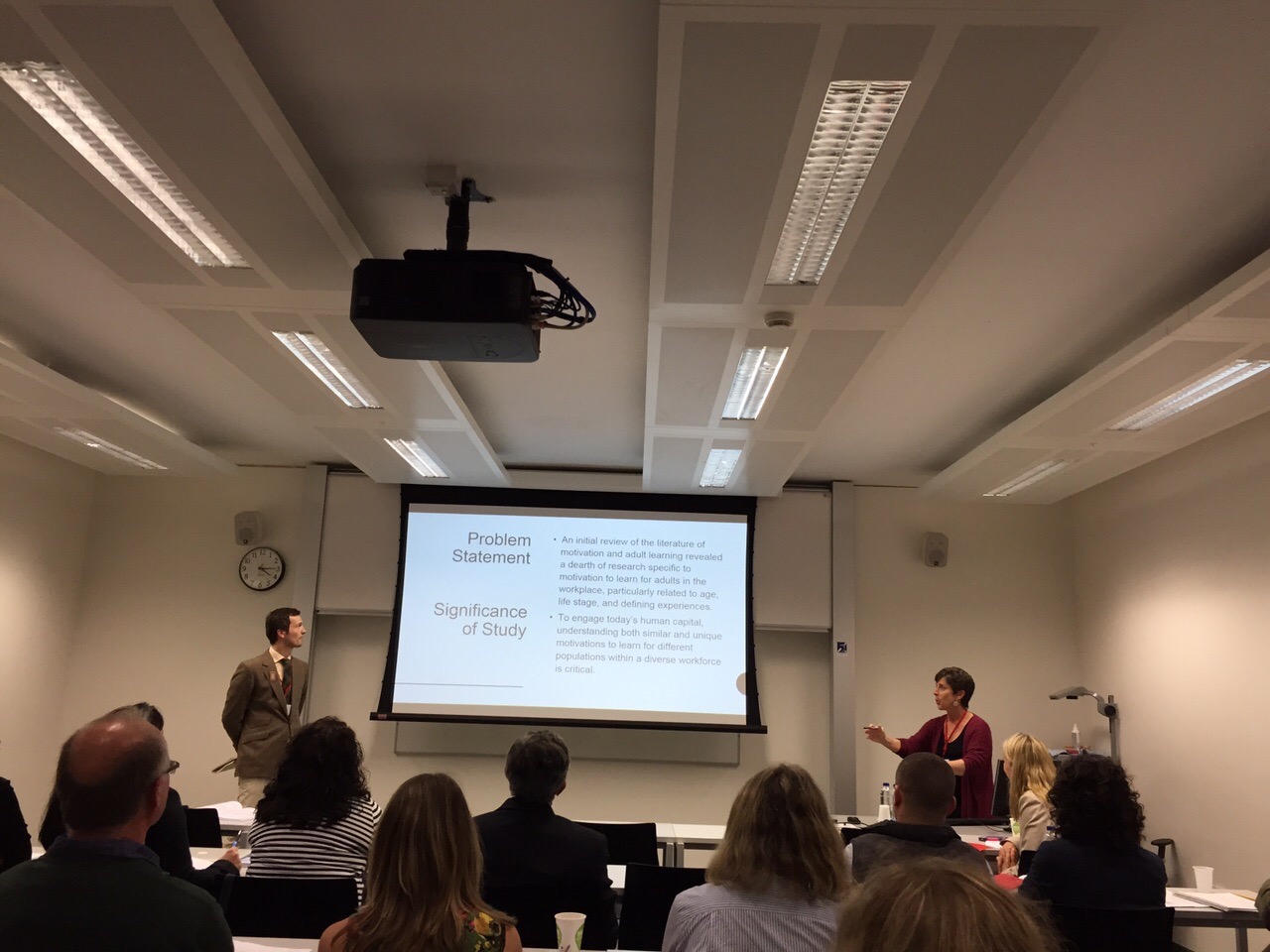 I had the opportunity to present a paper I have been working on with several of my colleagues on motivation to learn in the workplace. In the time following our presentation we had some interesting discussion regarding millennials’ motivation to learn in the workplace. There is a lot of contradicting literature on millennials in the workplace. On the one hand they seem to be self-starters, motivated by passion, and eager to learn. Other literature suggests they are insecure rule-followers at best and motivated by extrinsic rewards. I proposed that this discrepancy in the literature is likely due to the fact that millennials may be on a developmental edge. According to Bob Kegan’s Constructive Developmental Theory, it may be the case that the majority of millennials are caught between the Socialized Mind and the Self-Authoring Mind. If you’re intrigued to learn more, check out this blog post, which has some nice summaries of Kegan’s work.
Another interesting point from the discussion was the idea to look at the contracts companies typically offer millennials. Do contracts affect millennials motivation to learn? One criticism of millennials in the workplace is their apparent lack of loyalty. I wonder, however, if the lack of loyalty is a two-way street. For example, a small minority of my friends are working in a full-time job with a sustainable salary and benefits. Most of my friends stitch together multiple jobs, work far more than 40 hours a week, and have trouble getting comprehensive benefits. Loyalty must be earned, and I wonder if companies today are doing what it takes to earn the loyalty of millennials. My guess is most companies are not.
Overall, the conference was a fantastic experience. I loved the social aspect of it – meeting people with similar interests from all over the world, having conversations over lunches about interesting sessions we attended, and going out to pubs each night to enjoy Irish culture. I can’t wait for the next UFHRD conference. In the meantime, I am looking forward to the Asian HRD conference in November in Macau!
Course: International and Multicultural Issues in Organizations
Posted on June 16, 2015 Leave a Comment
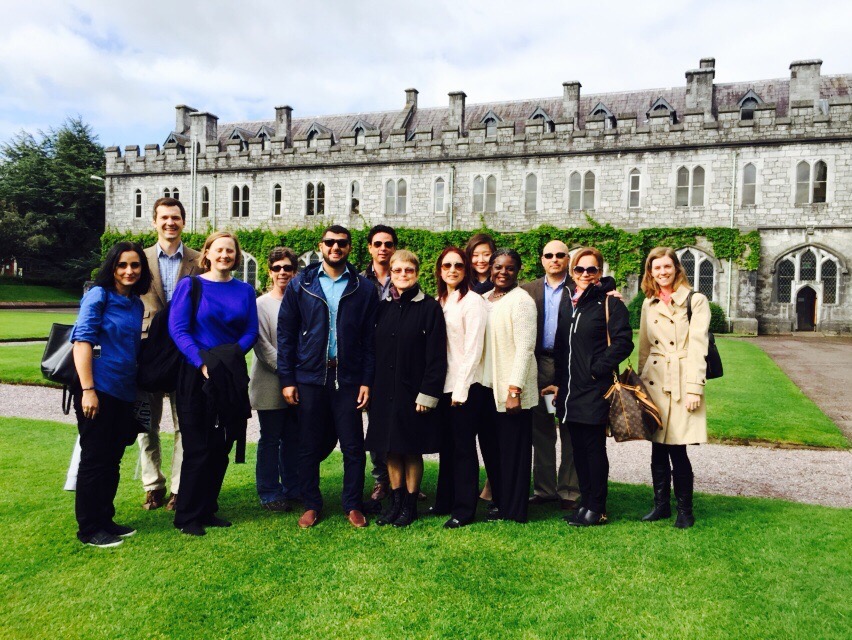
As part of my role as a Graduate Research Assistant at GW, I had the privilege of being the teaching assistant for a course called International and Multicultural Issues in Organizations. This course, led by Dr. Maria Cseh, revolved around the European Human Resource Development conference at University College Cork (UCC) in Ireland.
 Ireland’s Cork City is a beautiful, quaint town. I love these types of towns – large enough to to be full of twists and turns but small enough to get acquainted with it in a week’s time. Here’s the view of Cork from my hostel room:
 I flew into Belfast, Northern Ireland and made my way to Cork through Dublin. The journey took three different buses but I used the time to catch up on reading and sleep. Once in Cork, we spent two days visiting organizations, learning about the history of the area, and observing Irish culture. One of the organizations we visited was the Jameson Distillery where I was fully converted to the Jameson way. We did a comparative whiskey tasting session after the tour and spent time talking with three executives, each giving mini-presentations about the organization.
In Kinsale, a small town 30 kilometers south of Cork City, we learned about the history of this important harbor town with famous tour guide Don Herlihy. It was quite a special tour. It was raining heavily at the time of our tour so Don proposed we do the tour in his living room! He proceeded to shuttle us to his house nearby. We sat comfortably in his living room with tea looking out into the harbor through massive windows while he shared the history of the area. It was quite an experience!
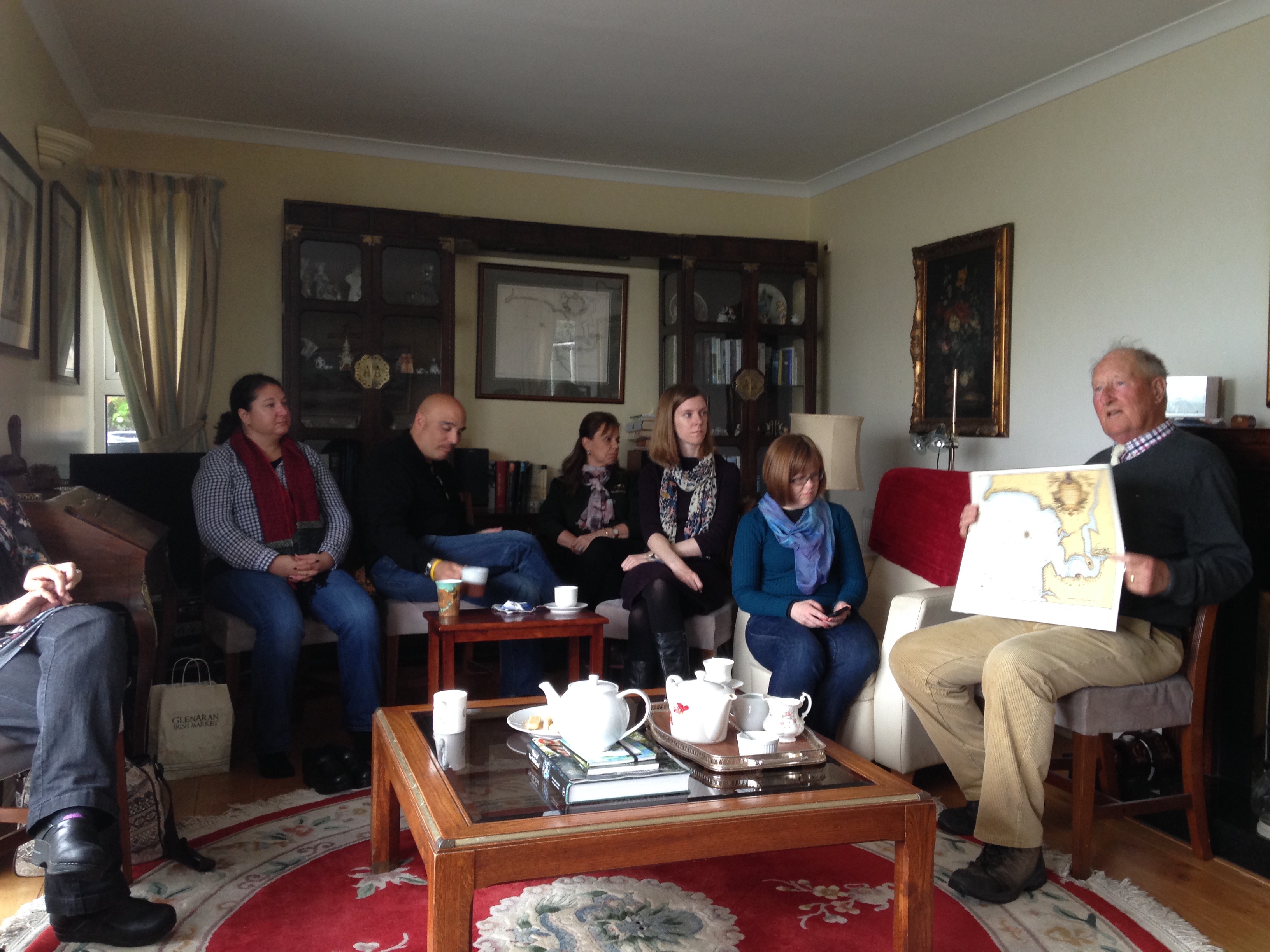 We spent the next three days at the UFHRD 2015 Conference. The conference had about 350 people from around the world with hundreds of presentations and keynote addresses. I enjoyed every minute of it. I especially relished the opportunity to meet some of the top scholars in the field of human resource development. Dr. Cseh was fantastic at introducing our class to various people. It was a very social three days full of meaningful interactions.
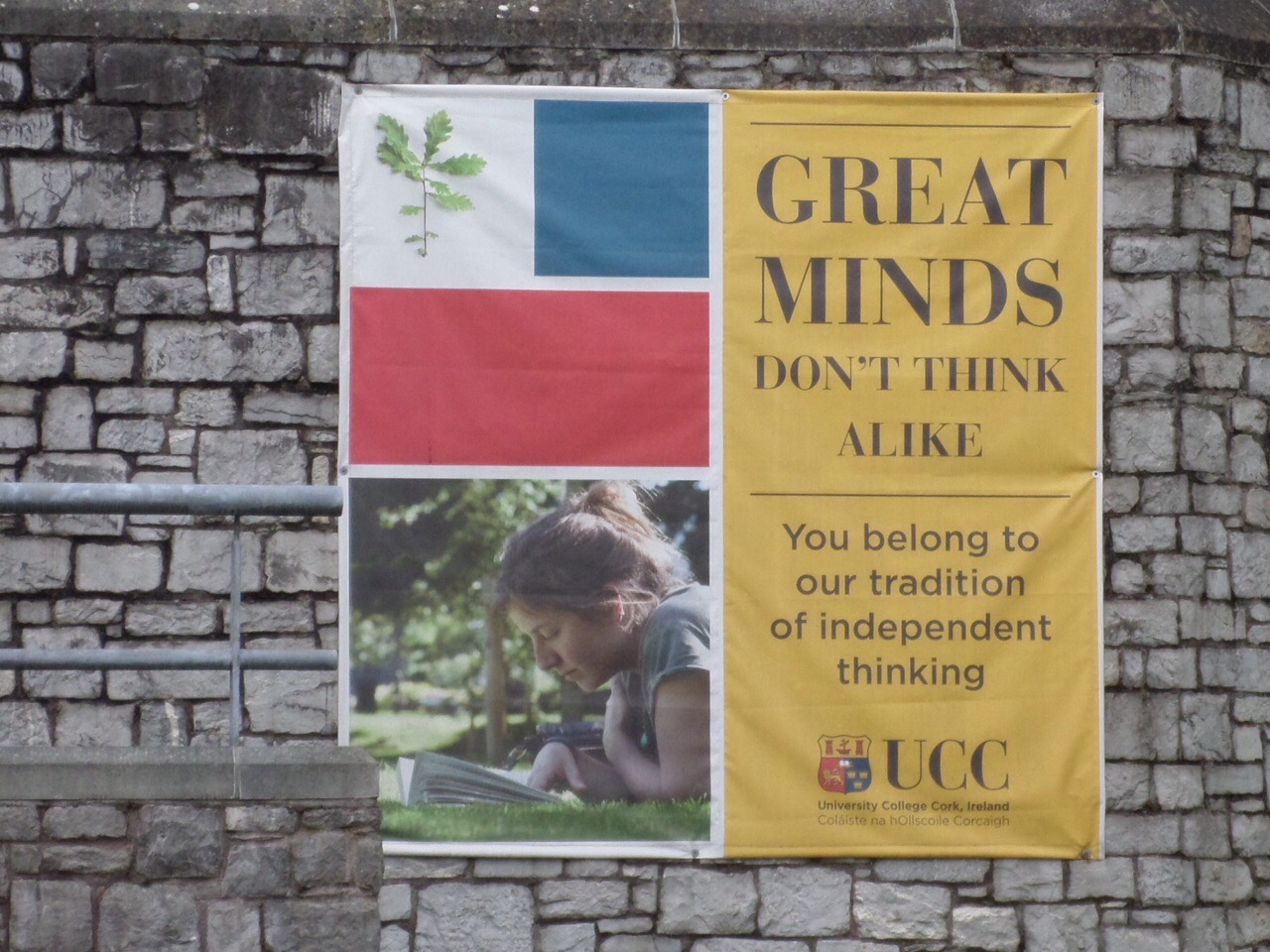
I appreciated this sign on UCC’s campus:
After the conference I went to London for a day to visit my dear friend, Amelia, who is currently a Ph.D. student at Harvard. I’ve always wanted to go to London and she did a marvelous job showing me around in our short time. She even took me to a small party in Wimbledon with all her Oxford friends – a true cultural experience! And I saw the home where she grew up. It was a memorable time indeed. I hope to return to England, if not work in that area at some point in my career.
As a side note, the public transportation in that region was fantastic! All in all I was in three countries and four different airports, and never once did I call for a taxi. I was on subways, trains, and buses. Most of the time I would walk from place to place if I could. Another observation I would make about Cork was the work-life balance. Everything but pubs closed at 5-6 PM. I couldn’t believe it. At first, I thought it was rather annoying and reflected economic weakness. But I grew to respect it as a reflection of their way of life – a way of life that I have become estranged from or perhaps never knew.
I cannot wait to return. Until then, I trust that I will carry at least some piece of the culture and people with me.
Happy Songkran at the Thai Embassy
Posted on April 26, 2015 Leave a Comment
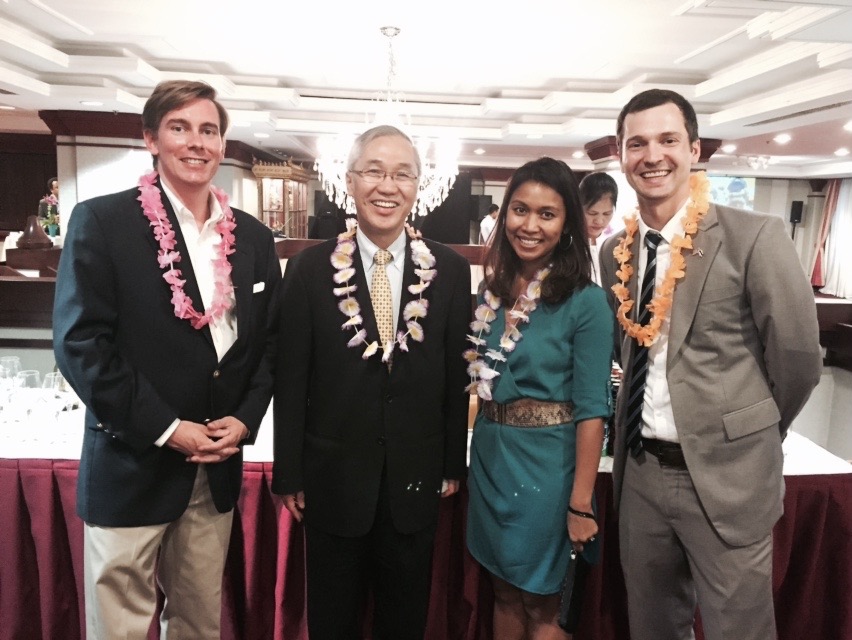
Thanks to my beloved friend, Tina Neville, I had the chance to attend a Songkran celebration at the Thai Embassy last week here in Washington, D.C.
I was thankful to meet the new Ambassador of Thailand to the United States, Pisan Manawapat, who took over for Vijavat Isarabhakdi in February.
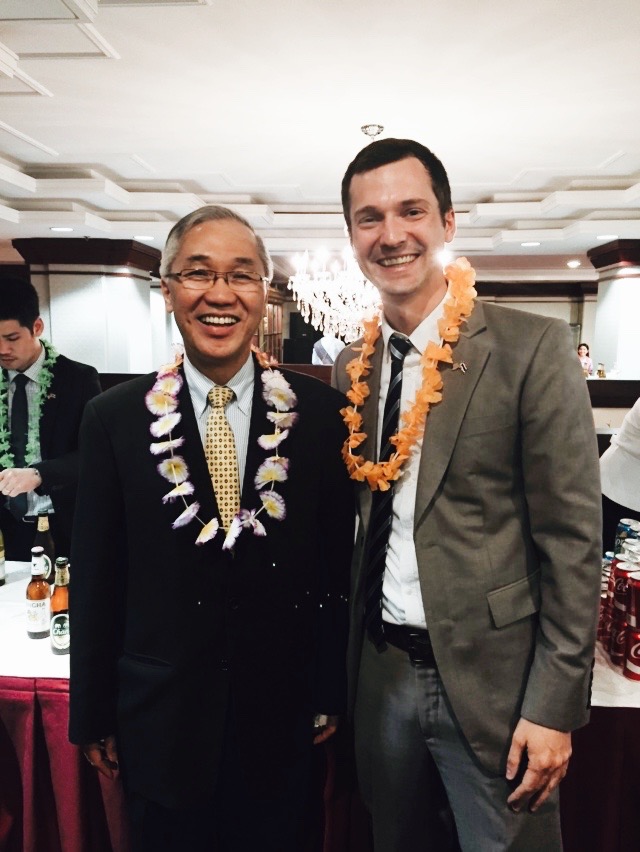 We talked on two occasions through the night. He was impressed with my Thai and alluded to something I said in his speech about the increasing prominence of the word “sanuk.” I found him to be the quintessential ambassador: friendly, kind, well-spoken, and generous. I was also interested to hear he went to Bangkok Christian College where my good friend Rob Collins used to teach 45+ years ago.
It was surreal to meet Khun Pisan in light of his recent letter to the editor in the New York Times in response to a scathing opinion piece. Perhaps needless to say, he and I did not talk politics but I enjoyed our conversation nonetheless!
Looking forward to returning to the Thai Embassy in the future.
Cosmopolitan curiosity
Posted on April 26, 2015 1 Comment
After living in Thailand for four years, I’ve become increasingly interested in anything I can get my hands on (and head around) that deals with living and working in mutually satisfying relationships across cultures. In my work with Dr. Maria Cseh in the Global Competence Enrichment Program at GW, we pair up international and American graduate students and do seminars and a service learning project together to help facilitate global competence enrichment. I will likely do my dissertation on something related to global competence but in the meantime I’m trying to read and learn as much as I can about what it means to have cosmopolitan curiosity.
Currently, I’m reading Cosmopolitanism: Ethics in a World of Strangers by Kwame Anthony Appiah, and it has a lot to do with living in a globalizing world. (As an aside, I read Appiah’s book The Honor Code a couple of years ago and loved it. I recommend both.) Appiah is a philosophy professor at Princeton, originally from Ghana, and educated in England. A few quotes stood out to me that I thought I would share here. These quotes come from a chapter that discusses conflicting values across cultures and the art of getting used to others.
“When we offer judgments, after all, it’s rarely because we have applied well-thought-out principles to a set of facts and deduced an answer. Our efforts to justify what we have done–or what we plan to do–are typically made up after the event, rationalizations of what we have decided intuitively. And a good deal of what we intuitively take to be right, we take to be right just because it is what we are used to.”
Later he concludes by saying:
“I am urging that we should learn about people in other places, take an interest in their civilizations, their arguments, their errors, their achievements, not because that will bring us to agreement, but because it will help us get used to one another. If that is the aim, then the fact that we have all these opportunities for disagreement about values need not put us off. Understanding one another may be hard; it can certainly be interesting. But it doesn’t require that we come to agreement.”
These ideas stand out to me. Firstly, the idea that our judgments typically come first from intuition is something that has been front and center in recent social science research. Daniel Kahneman’s Thinking, Fast and Slow is a fantastic summary. I also recommend Jonathan Haidt’s The Righteous Mind for a look at that idea as applied to moral psychology.
I find this theory moving: our judgments are rooted in our intuition (before/more than rationality) and much of our intuition is based on what we’re accustomed to. Therefore, getting used to one another will go a long way in helping us live together.
What’s the key to cosmopolitanism and living as a global citizen?
I am a chapter and a half from the end of Appiah’s book but this much is clear: to live and work effectively across cultures takes an almost radical disposition of curiosity and imagination. The more I learn about ideas like global citizenship, cross-cultural communication, intercultural competence, global mindset (the list goes on…), the more I am learning that curiosity is a key component. I’ll write more about this later because I’m just now starting to investigate what it means to be curious. For now, let me conclude by with this:
How would the world look if we embraced a disposition of radical curiosity for the thoughts, beliefs, actions, perspectives, and practices of others? How, if at all, would it change our relationships?
Onward.

My Journey to The George Washington University
Posted on April 18, 2015 2 Comments
Last month I spoke to the Dean’s Council at the Graduate School of Education and Human Development about the story of my journey to GW. I thought I would share some of that story here on my blog as well:
My name is Oliver Crocco but you can call me Ozzie. I’m a first year doctoral student in the Human and Organizational Learning program and a Graduate Research Assistant here at the Graduate School of Education and Human Development.
Last week I attended a book launch of Harvard professor Tom Herir’s (former US Department of Education’s Office of Special Education Programs) new book “How did you get here? Students with disabilities and their journeys to Harvard.” In the book, Herir and his coauthor Laura Schifter interviewed 12 people with disabilities and asked them how they got to Harvard.
It’s a powerful concept for a book. Not all of us have identifiable disabilities but everyone has a journey. How did each one of us go from being a curious child to the position we’re in today? So today I thought I would share with you all briefly my story of “How did I get here?” to GW – and I want to focus on four pivotal moments.
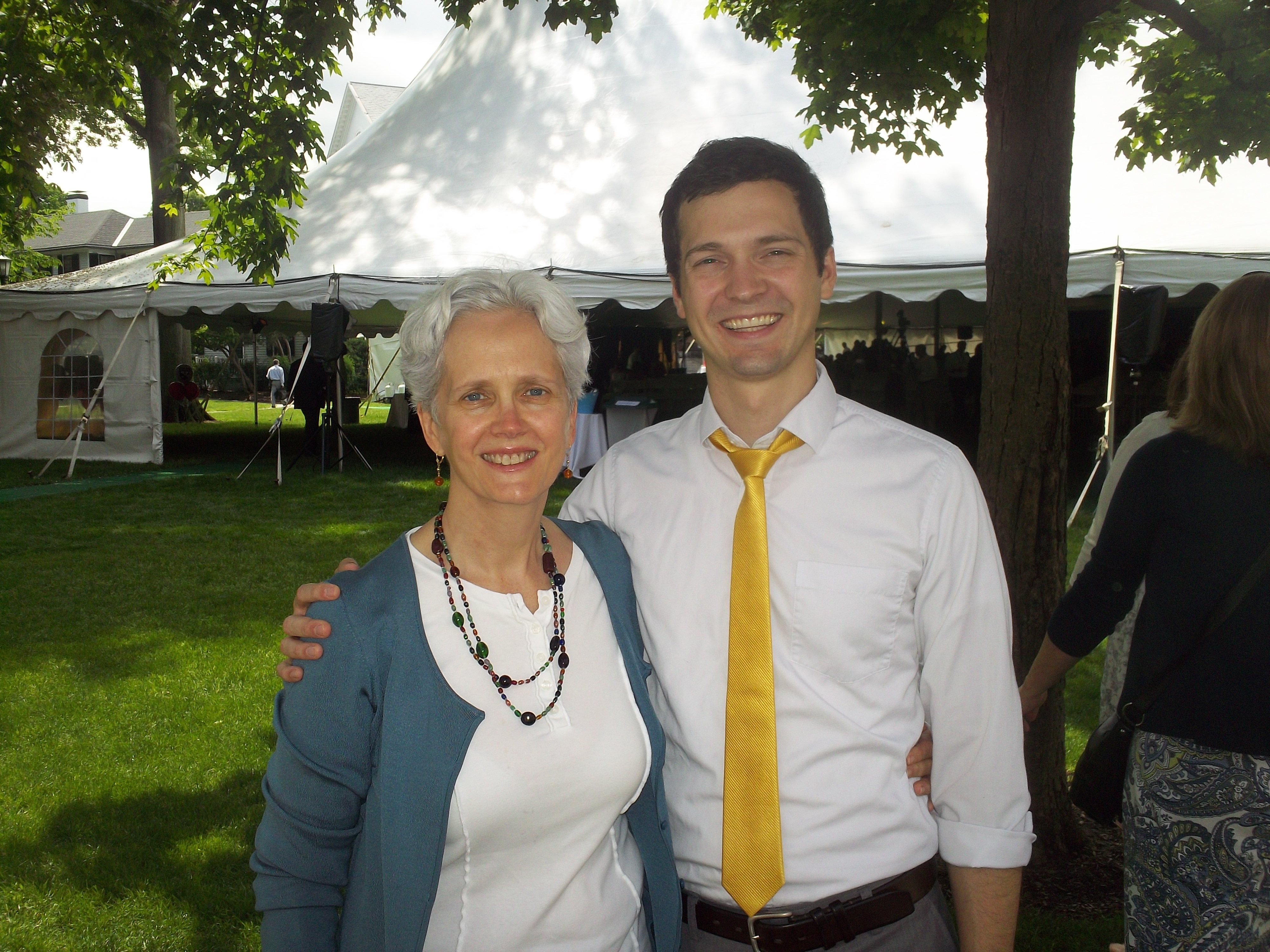
Pivotal moment #1 – My Mother
The first chapter of Herir’s book about students with disabilities studying at Harvard is aptly titled “My Mother.”
I grew up with dyslexia. Language seemed impossible for me to grasp, so much so that my mother called English was my second language. I was homeschooled through seventh grade where my mother taught me how to read using clay. In 8th grade, I attended The Lewis School of Princeton, which is a private school in Princeton that supports students primarily with language-based learning differences. They always called them “differences” instead of “disabilities.” I’ve come to do the same.
The support of my mother along with many others in my early life allowed my natural curiosity to flourish. She helped preserve a love of learning in my life. This is rare considering how much our society makes us hate learning or see learning merely as a means to an end. And in my case as a dyslexic, I was primed to despise reading and learning as our society made it out to be. Thankfully my mother and my experiences at the Lewis School preserved my love of learning and I continued to see it as an end in itself and not a frustrating and boring means to another end. As a result of my learning differences, I also developed other skills and interests, which Malcolm Gladwell talks about in the book David and Goliath.
Pivotal moment #2 – Life in Thailand
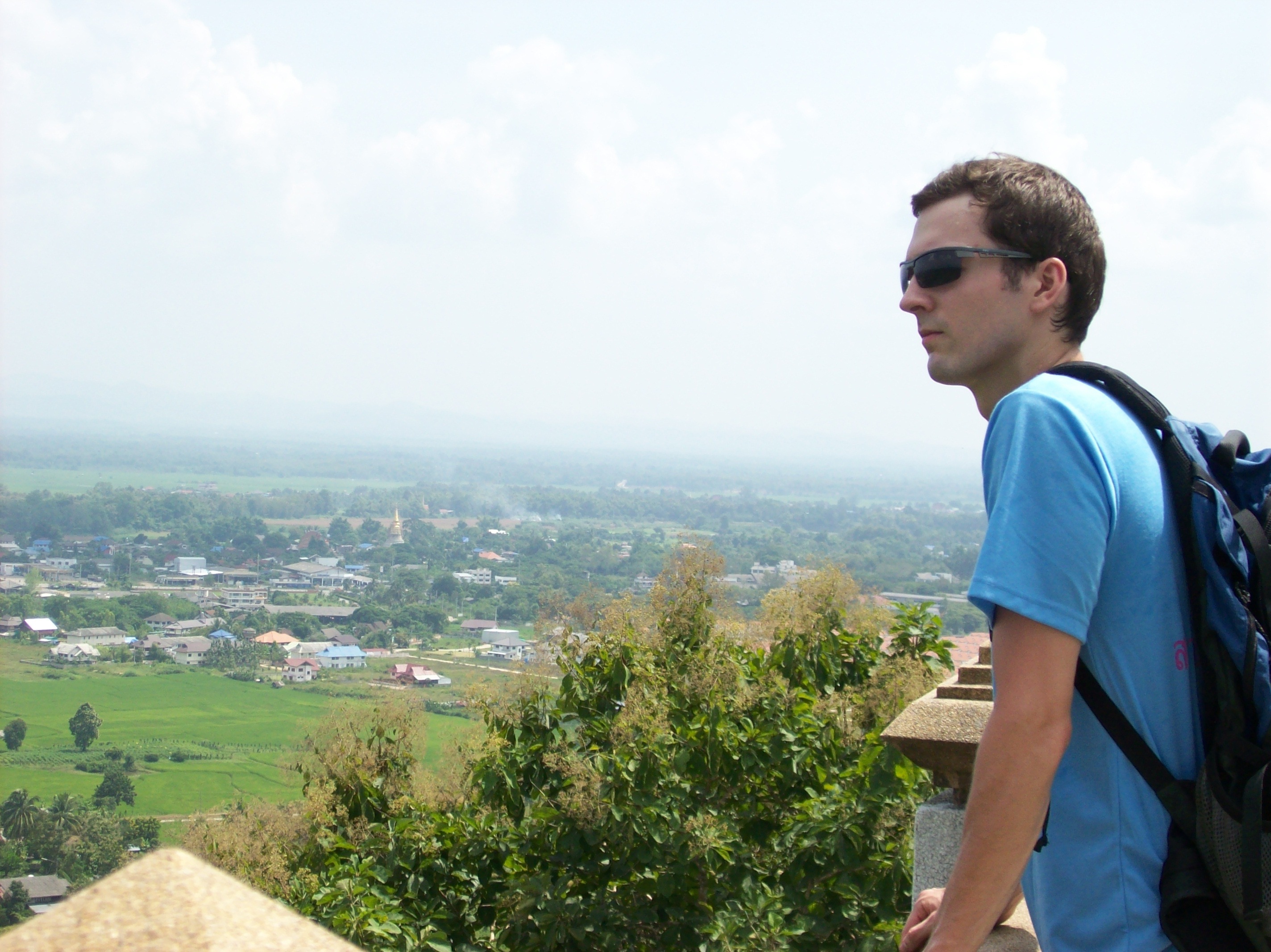
After I graduated from college, I decided somewhat precariously to move to Thailand to become a Residential Life Assistant and Instructor at Payap University in Chiang Mai.
I thrived. Thai food, motorcycles, ultimate frisbee, Thai language, culture, faith, Buddhism, living in the moment, you name it. I had a powerful two years in Thailand and loved every minute of it. That’s not to say my time wasn’t full of perpetual blunders, misunderstandings, failures, and frustrations. It was. But I managed with an abundance of support and forgiveness.
I blogged all the time those first two years and my sister published the posts into a little book. It’s such a treasure to go back and see how I made meaning of my experiences then. I began to learn just how big and wonderful the world is.
Pivotal Moment #3 – Going to Harvard
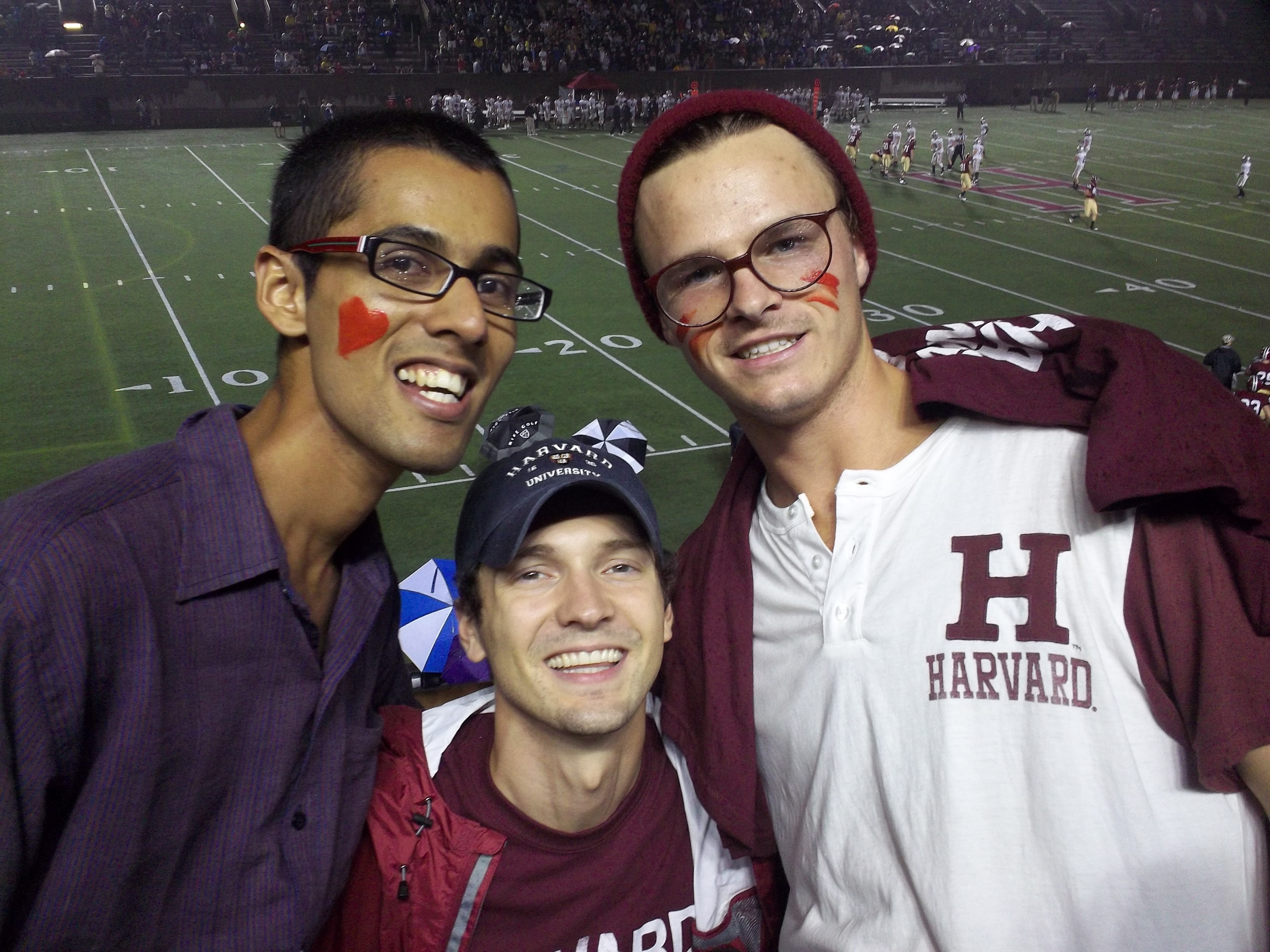
The third pivotal moment for me came while studying my Ed.M. in Human Development and Psychology at Harvard. I studied and learned from so many awesome scholars like Bob Kegan, Rick Weissbourd, and Bruno dell Chiesa. My favorite part about being at Harvard, though, was not the classes but my classmates. Whether at a beer garden or burrito joint, I learned so much from our conversations. GK Chesterton talks about creating spaces “for good things to run wild,” and Harvard did this to perfection.
It was at Harvard that I finally began working through my people-pleasing, which I felt was plaguing my life up to that point. I also began to see more and more how interconnected the world is. By the time I finished my time at Harvard I was positive I wanted to pursue doctoral studies. I loved the inquiry, research, evidence, and learning how to ask and answer questions.
Pivotal Moment #4 – A phone call
In 2012, I returned to Thailand as the Head of International Campus Life and Lecturer in General Education. My research interests began expanding. I presented at several conferences in the region including a UNESCO conference in Bangkok at which my paper was later published.
As I began looking for doctoral programs, the obvious choice was to work with the top scholar in the field of Southeast Asian education development at the University of Minnesota. I knew him and had worked with him on a few things including a book chapter that is being published later this year.
However, I wanted to look at a few other schools, especially close to my home in New Jersey, seeing as I had been away for so many years. Also, finances were of utmost importance. For graduate study to be a possibility it had to be financially viable. I applied to a short list of universities that would allow me to work with people with whom I had similar research interests.
One day at 2:00 in the afternoon, which was 2:00 in the morning for people in the US, I got a phone call from a very gregarious European woman named Dr. Maria Cseh. I was so glad she called because her work on international human resource development had intrigued me when I was looking for doctoral programs. We talked for a while and eventually they offered me admission to the doctoral program as a Graduate Research Assistant. Truly, Dr. Cseh’s intentionality, relational nature, and the Graduate Research Assistant position made up the linchpin in my decision making process. And I’m so thankful to be here at GW today.
Now, as I think about graduating from GW in 2018, I will be pursuing jobs where I can lead a life of research, teaching, publication, and service. My hope is to use my energy, skills, knowledge, and attitude to serve others and the world as a whole.
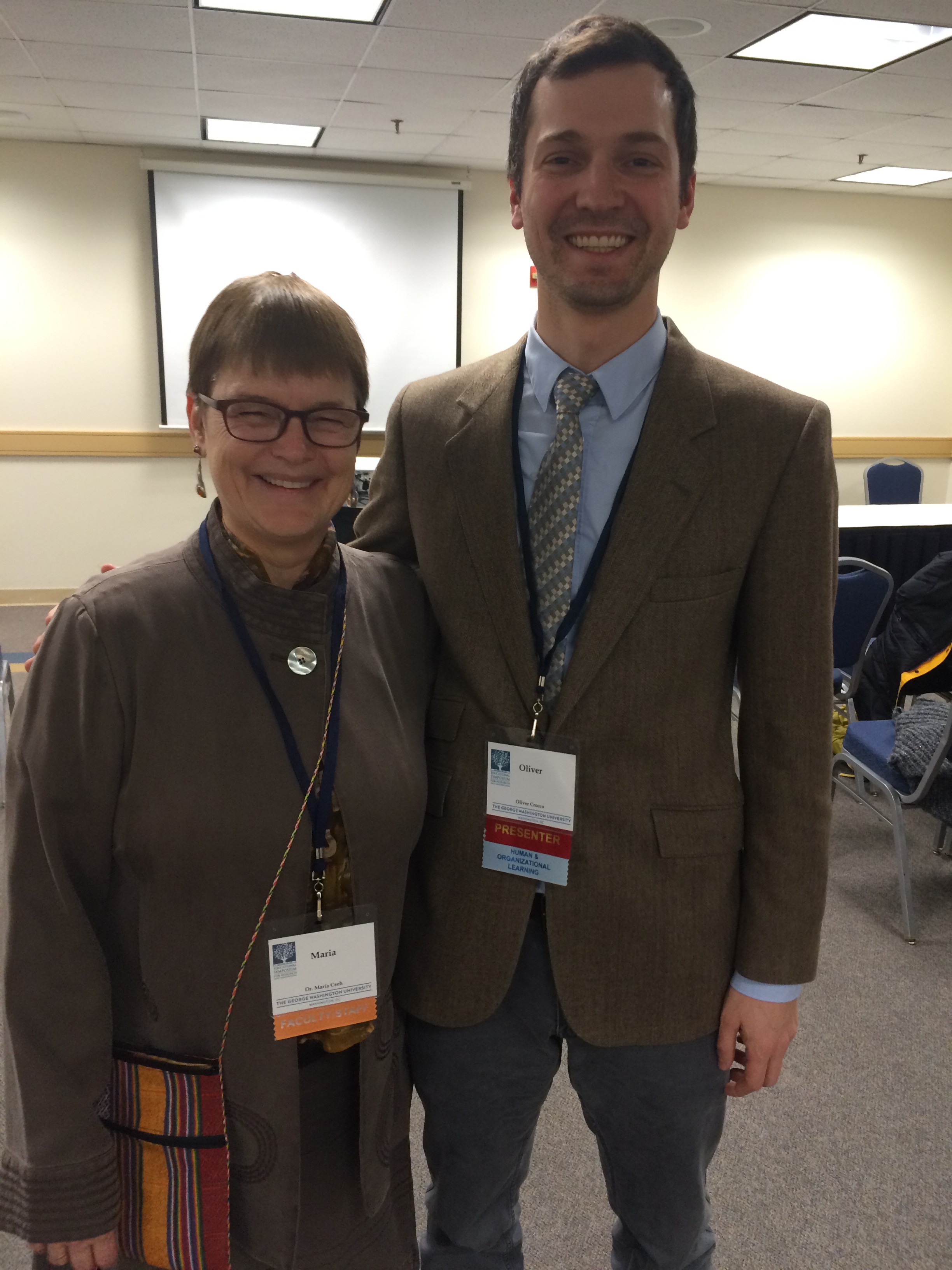
There are no simple answers to question “How did you get here?” And I’m not sure how the next chapter will go. That’s okay. I have been privileged, lucky, honored, and blessed to have had these experiences and people in my life thus far, and whatever happens I hope to share those with others along the journey.
What does diversity and inclusion mean to you?
Posted on April 15, 2015 2 Comments
I attended a half-day conference at The George Washington University last week on diversity and inclusion in the workplace sponsored by one of the big consulting firms in the US. My adviser, Dr. Maria Cseh, co-led one of the breakout sessions entitled Leading and Engaging Our People. I have four short reflections I want to share – two positive, two more critical – and one concluding thought. Then, I’d love to hear your thoughts on this topic as well.
Firstly, there were artists depicting what happened in the sessions on large pieces of paper. These visual representations were remarkable and helped think about different ways of making meaning of the talks. Also, these visual depictions allowed us to get the highlights of sessions we weren’t able to attend.
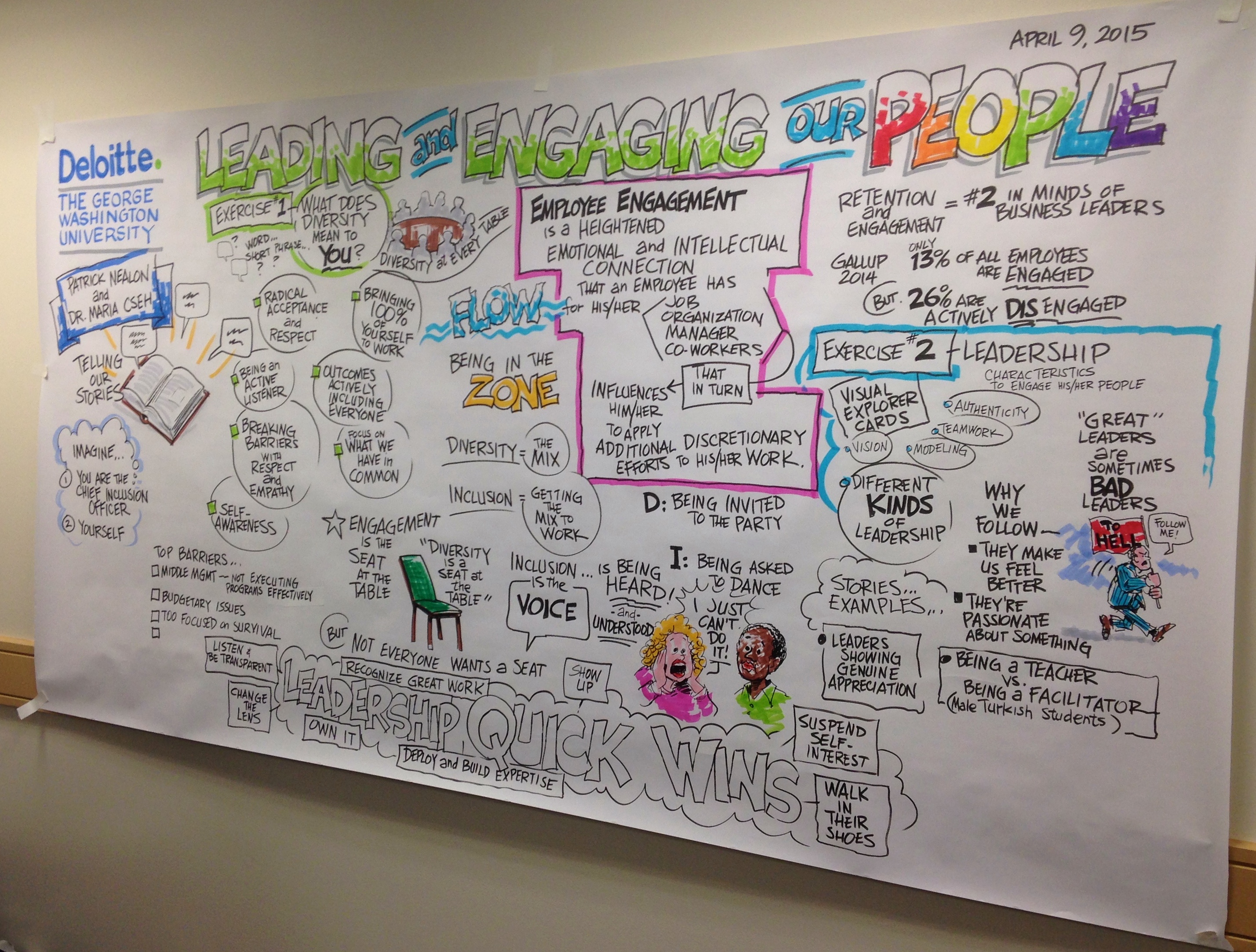 Secondly, I thoroughly enjoyed our breakout session on Leading and Engaging Our People. In small groups, we did two activities. The first activity asked us to “come up with a phrase that describes what diversity and inclusion means to you.” We shared in our small groups and it was interesting to hear the various thoughts. In the minute we had to think of our answers, I came up with this: to me, diversity and inclusion mean radical acceptance, respect, and compassion for every person. How one defines “radical” is up for debate but I wanted to get across a certain depth and even counter-cultural degree of acceptance, respect, and compassion. The second activity involved cards with pictures on them. The pictures seemed random, disconnected, and even strange. We were asked to pick a picture and explain how it describes leadership. I picked one of some cyclists and talked about drafting off one another. Overall, the breakout session was great.
Now on to a couple points of criticism.
For a talk on on diversity and inclusion, I was shocked at how homogenous the group seemed to be. While the types of diversity are unlimited, at least two kinds of diversity appeared eerily absent: Socioeconomic status (SES) and diversity of thought. Obviously I cannot know for sure that either one of these things was in fact absent as they are mostly invisible, but it didn’t take long for me to feel that these types of diversity were underrepresented. Everyone looked somewhat the same in their suits and nice shoes, and everyone talked in similar ways as if with the same underlining philosophy.
I must admit that because of the way my life has unfolded, my brushes with corporate America have been brief. I wasn’t prepared for what is my second criticism: the implicit treating of people (especially with regards to diversity and inclusion) as a means to an end. Treating others as an end in themselves and not a means to an end is the foundation of Kant’s ethics. While I’ve known these ideas in theory, I was really confronted with them at this conference. At the panel discussion, several of the panelists alluded to the importance of convincing business leaders that diversity is important for business outcomes. I was offended. I know we live in a capitalist society but that doesn’t mean we need to put a dollar sign on someone’s diversity as the only way to get them included in the workplace. I’m not advocating that businesses take on people simply as “diversity hires,” I just want to think about how we treat people.
My concluding thought is this: Let’s have a conversation about how we treat people in organizations. How do we view people that we live and work with? Do we see them as a means to our happiness, profit, or success? How does this affect the quality of our relationships and business as a whole? My hope is to grow to treat all people as beautiful, wonderful, uniquely talented, and valuable, interconnected with one another and the natural world in dynamic relationship.
Thoughts?
Conference: Comparative and International Education Society (CIES)
Posted on April 3, 2015 Leave a Comment
In March, we had a fantastic CIES conference here in Washington, D. C. CIES is the Comparative and International Education Society, which is essentially the largest international education conference in the country. It was so convenient being here in DC and I was more than glad to welcome three friends to stay with me for the conference (two from Stanford and one from Harvard).
I presented with my adviser, Dr. Maria Cseh, a poster on Global Competence Development in Higher Education in Thailand: A case study of a mid-size private university. We looked at external forces such as government policy, the Association of Southeast Asian Nations (ASEAN), and globalization and how those forces affected what the university is doing to promote global competence in their faculty and students.
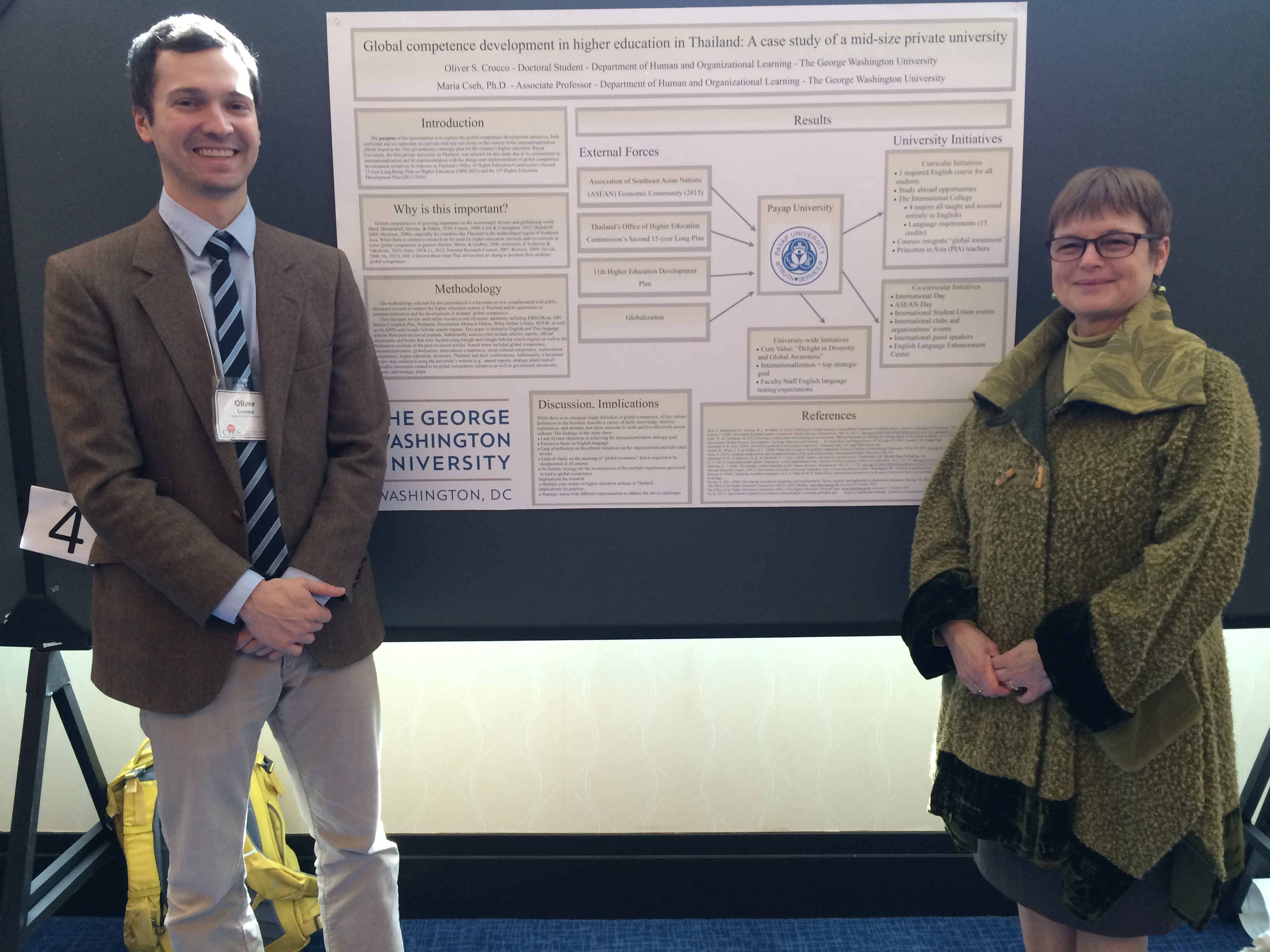 The conference was a great experience and I enjoyed the conversations we had with the other presenters and participants. It’s fascinating to see how people conceptualize global competence. For example, one woman described that the word competence to her means a measuring stick and a specific ability. This contrasted with our understanding of competence in what originates as more of a state of being and dynamic capacity.
I also got to meet up with several friends from the Harvard Graduate School of Education (HGSE) who presented at the conference as well, including Maung Nyeu.
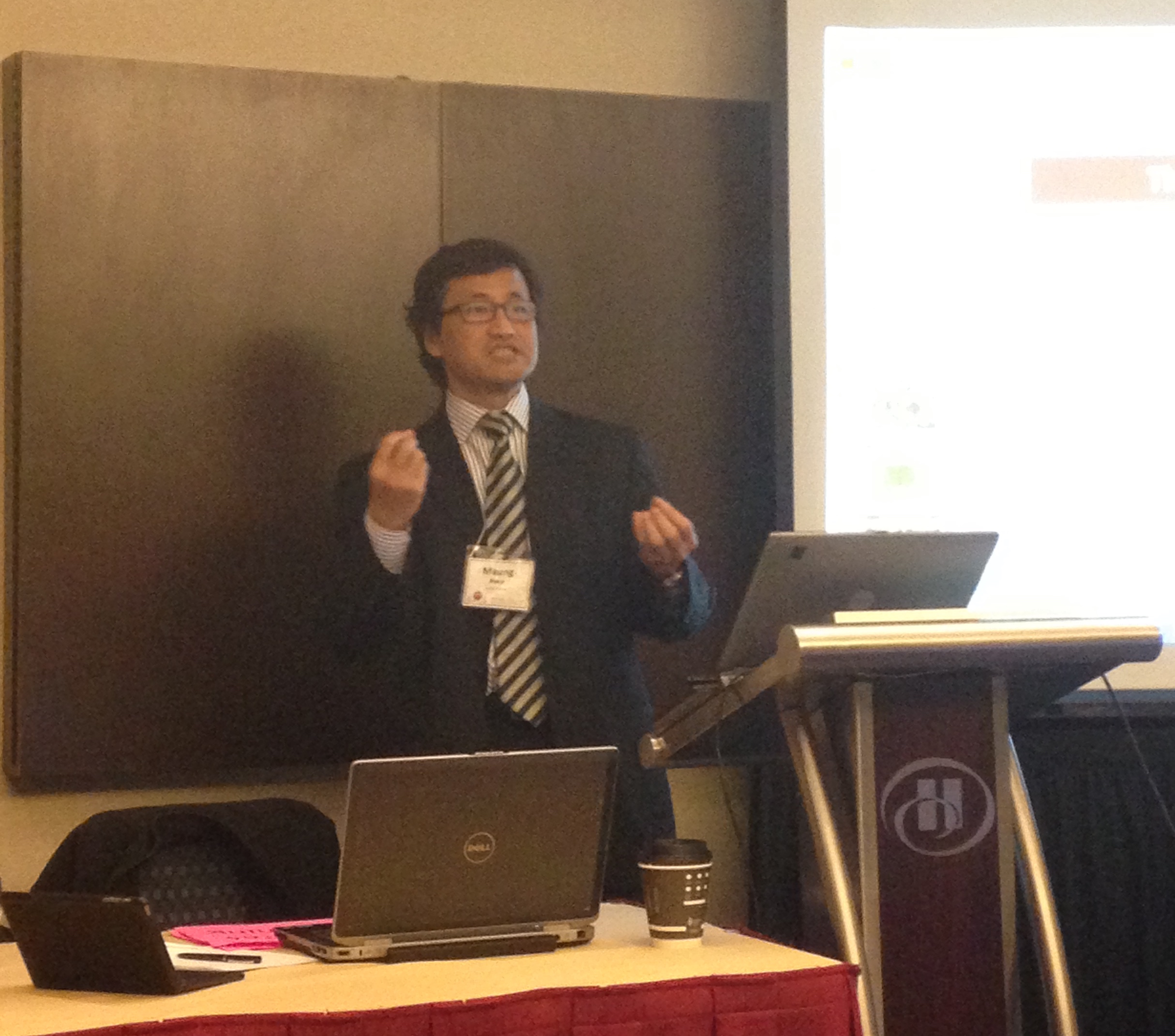 Looking forward to more conferences and hopefully attending CIES next year in Vancouver, British Columbia.
Ozzie
Amazing Course in Ireland – Summer 2015
Posted on April 3, 2015 Leave a Comment
One of the great things about being at the Graduate School of Education and Human Development (GSEHD) at The George Washington University is opportunities like this summer course: HOL 6747 – International and Multicultural Issues in Organizations.
From June 1-5, I am going with my adviser Dr. Maria Cseh and a class of students to Cork, Ireland to study international and multicultural issues in organizations. We will make site visits to a variety of organizations, meet leaders or industry, and attend the 16th Conference on Human Resource Development Research and Practice.
Here is the course description from the syllabus:
This course will explore the impact of culture and globalization on the lives of individuals, organizations and societies. It will examine models and conceptual frameworks of culture to understand the nature of learning, change and leadership across cultures with a focus on Ireland. Topics discussed will include the meaning of culture, cultural models and conceptual frameworks, cross-cultural communication, learning, change and leadership across cultures. The discussions related to the assigned comparative and cross-cultural studies and the reflections on experiential activities will lay the background for exploring alternative approaches to managing and developing employees, organizations, communities and societies.
Needless to say I am thrilled to be going and supporting Dr. Cseh. And there’s still room if any GW students are reading this and would like to join! If you’re interested, please email me at olivercrocco@gwu.edu or Dr. Cseh at cseh@gwu.edu.
Onward in learning!
Ozzie
 Oliver S. Crocco